Judaism

The Torah’s two very different cows

Holy cow! Or should I say, holy cows! This week cows fill our Torah reading, from the sin of one cow, the golden calf, to – this being Shabbat Parah – another cow, the red heifer. Shabbat Parah, the Sabbath of the Red Heifer, occurs on the Shabbat prior to Shabbat Mevarkhim of the month of Nisan. This brings to mind a question. What do you get when you pamper a cow? Spoiled milk, that’s what! Ok, ok, it’s just a bad joke, I get it. But why did the secret service surround the president with dozens of cows? Of course, they were trying to beef up security. Ugh, I now, but writing this so close to Purim leaves its mark of still overflowing fun. [Michael Mantell, Ph.D]

The Torah’s two very different cows Read More »

Jewish Religion, Michael Mantell
Purim in the House of Mozes

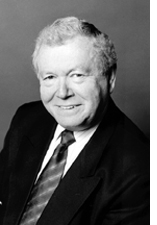
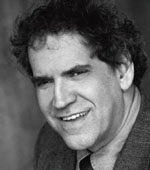
Purim was celebrated this year in Israel and perhaps elsewhere also as a respite from worrying about the spread of the coronavirus (epidemic? pandemic? panic?). In the old-age home (pardon: “parents’ home; golden age residence; 55 and better”) where my wife and I live, the residents put on a splendid Purim Spiel depicting Biblical characters from the Creation until Queen Esther and beyond. In the presentation, God spoke in English with a marked non-British accent. Delilah was suitably dressed but appeared with her walker. Etc. etc. etc. [Rabbi Dow Marmur]

Purim in the House of Mozes Read More »

Jewish Religion, Middle East

Haman, Purim, and Holocaust

During the Holocaust years, Purim celebrations were forbidden to the Jews. Christians and Jews could not even own the book of Esther. Such decrees did not stop the Nazis from poking fun at the Jews on this Jewish holiday. With diabolical glee, the Nazis frequently orchestrated special killings with the Jewish festivals. On Purim in 1942, the Nazis hanged ten Jews in Zdunka Wola to avenge the hanging of Haman’s sons. Similar incidents occurred in the Piotrkow ghetto and in Czestochowa and Radom. [Rabbi Dr. Michael Leo Samuel]

Haman, Purim, and Holocaust Read More »

International, Jewish History, Jewish Religion, Michael Leo Samuel-Rabbi

Jewish Federation monitoring CDC’s meetings advice

The Jewish Federation of San Diego County “at this time” does not plan to cancel any of its meetings or events in response to the coronavirus pandemic. “However,” assured Michael Jeser, its CEO and president, “should the situation warrant, we will inform participants immediately if another decision is made.” [Our Shtetl San Diego County column by Donald H. Harrison]

Jewish Federation monitoring CDC’s meetings advice Read More »

Cantor Sheldon Foster Merel, z"l, Donald H. Harrison, Jewish Religion, Middle East, San Diego County, Shor M. Masori, Travel and Food, USA

March of Living postponed; 12 local residents affected

Eight students and four adult leaders from San Diego County who had expected to participate during April in the annual “March of the Living” – a two-week trip including the concentration camps in Poland and a visit to the nation of Israel – have received news that the journey has been cancelled because of the coronavirus. [Our shtetl San Diego County column by Donald H. Harrison]

March of Living postponed; 12 local residents affected Read More »

Donald H. Harrison, International, Jewish Religion, Marcia Tatz Wollner, Middle East, San Diego County, Travel and Food, USA

Esther is the true heroine of Purim

Esther is the brave face and conscience of Purim. She is weeping from above for the suffering peoples of today–and for all the girls and women enslaved and brutalized by the jihadists. I love her story, one rooted in real, painful history, harvested from the timeless male penchant for shackling women and exhibiting brutality, because—unlike any other book in the Hebrew Scripture—it never mentions the divine name. Indeed, God is not quoted, cited, or present even once. The Scroll of Esther is being chanted in synagogues over the entire world this month even as Jewish revelers make noise to drown out of the name of the genocidal Prime Minister Haman. [The hissing and booing and even the drunken shrieking should only extend to today’s Hamans—from Kim Jong-un to Khameniei to Isis and on and on.] [Rabbi Ben Kamin]

Esther is the true heroine of Purim Read More »

Jewish Religion

Mordecai, not Esther, was the real hero of Purim

Esther was not a heroine. She repeatedly expressed hesitation from the moment that Mordecai requested that she speak to the king to save the Judeans from Haman’s decree, to every encounter she later had with the king. She needed the assurance gained by having people fast for her safety. It appears that she was unable to talk to Ahasuerus when she approached him after the fast because she feared for her life, so instead of revealing why she came she invited him and Haman to a feast. Even at the feast, she was hesitant and stalled by inviting the pair to a second feast. Mordecai is the hero of Purim. It is he, not Esther, whom the book praises in its conclusion. According to II Maccabees 15:36, Adar 14 was called the “Day of Mordecai.” [Rabbi Dr. Israel Drazin]

Mordecai, not Esther, was the real hero of Purim Read More »

Israel Drazin-Rabbi Dr., Jewish Religion

Works of Holocaust poets performed at LFJCC

“That was the last butterfly. Butterflies don’t live in the Ghetto” wrote Pavel Friedmann in Terezin, before he was deported to Auschwitz, where he perished in 1944. Myla Wingard opened the March 3 program in the Astor Judaic Library, Poets of the Holocaust, with an inspiring musical rendition of that iconic poem. “Never say that you are going your last way.” Those words, penned by Hirsh Glik, became the anthem of the Jewish Partisans. The Ohr Shalom Choir was joined by the audience in singing that song of defiance and hope to conclude the program in which fifteen poets were represented. [Eileen Wingard]

Works of Holocaust poets performed at LFJCC Read More »

Books, Poetry & Short Stories, Eileen Wingard, International, Jewish History, San Diego County

A Czech woman’s journey through the Holocaust

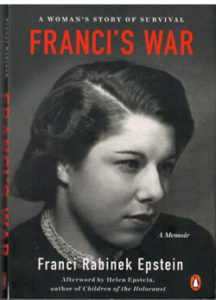
Published  posthumously with the help of her author daughter Helen Epstein, Franci’s War by Franci Rabinek Epstein is a well-written step-by-step recounting of Franci’s experiences during the Holocaust. A dress designer of  good reputation in Prague, Franci was transported with her parents to Terezin, the Nazis’ “model ghetto” nearby.  She was able to secretly rendezvous with her first husband, Pepik “Joe” Solar, who had been arrested and sent away earlier than she was.  Soon, however, her parents were taken on another transport to their deaths, and with Joe leaving the ghetto daily to work as slave labor on a railroad spur, Franci often was left to her own devices [Donald H. Harrison]

A Czech woman’s journey through the Holocaust Read More »

Books, Poetry & Short Stories, Donald H. Harrison, International, Jewish History

A Word of Torah – You should command

What we do not find mentioned in this week’s portion is the name Moses. This is an anomaly, which grabs the attention of the Sages, as Moses’ name appears in every portion of the Torah from the time he is first introduced to us at the beginning of Exodus to the time of the Book of Deuteronomy, which Moses wrote largely in the first person. This omission is strange especially when one considers the fact that Moses is referenced numerous times within the portion, as he is commanded to do numerous things. [Rabbi Yeruchem Eilfort]

A Word of Torah – You should command Read More »

Jewish Religion, Yeruchem Eilfort-Rabbi

Don’t let the light burn out

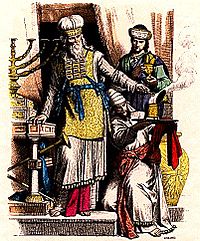
This week’s parasha opens with very clear instructions on how to create and maintain the ner tamid, a light much like the chanukiyah, not to be used for any practical purpose but rather to amplify our connection to Hashem. Indeed, the Talmud Bavli in Masechet Shabbat (22b), tells us the ner tamid is a symbol of Hashem’s presence and that the flame of Torah, our deepest values, are similarly eternal. “And you shall command the children of Israel, and they shall take to you pure olive oil, crushed for lighting, to kindle the lamps continually. In the Tent of Meeting, outside the dividing curtain that is in front of the testimony, Aaron and his sons shall set it up before the Lord…”(Exodus 27:20-21). [Michael Mantell, Ph.D]

Don’t let the light burn out Read More »

Jewish Religion, Michael Mantell
Purim differs from the biblical requirement

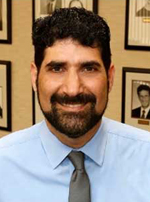
The current practice is that Purim is celebrated as a one-day holiday. Cities that were walled at the time of Joshua’s conquest of Israel – most notably Jerusalem – celebrate Purim on Adar 15, as a commemoration of the end of hostilities in the walled city of Shushan, where the battles occurred on Adar 13 and 14. Elsewhere, the holiday is observed on the one day of Adar 14, to recall the cessation of the battle after the war on the thirteenth in all other places of Ahasuerus’s kingdom. [Rabbi Dr. Israel Drazin]

Purim differs from the biblical requirement Read More »

Israel Drazin-Rabbi Dr., Jewish History, Jewish Religion