Judaism

Kapparot ceremony is unnecessary cruelty to animals

Yom Kippur has its own unique customs and traditions, and one of the most historically controversial customs involves taking a chicken and swinging it around one’s head. When I was a Hassidic youth, I recall getting up early in the morning before dawn to reenact the tradition better known as “Shlugging Kaparos,” or “Kapparot.” (To read more, please click on the headline.)

Kapparot ceremony is unnecessary cruelty to animals Read More »

Jewish Religion, Michael Leo Samuel-Rabbi, The World We Share

Two rabbinic leaders disputed Torah in ancient times

Two Talmudic sages lived around 130 CE and disagreed on how to interpret the Bible. Rabbi Akiva won out, and Rashi, Nachmanides, and most ancient Bible commentators as well as most Midrashim follow his view. Others, such as Rashi’s grandson Rashbam, Abraham ibn Ezra, and Maimonides interpret the Torah as Rabbi Ishmael did. (To read more, please click on the headline.)

Two rabbinic leaders disputed Torah in ancient times Read More »

Israel Drazin-Rabbi Dr., Jewish History, Jewish Religion

Jews excluded from British Holocaust commemoration

In a chilling message about the future of Britain, the University College Union in Britain sent out an email to all their groups informing them of the Holocaust Memorial Day 2020 commemorations next year. What is chilling is the fact that they listed trade unions, Roma gypsies, gays and lesbians, black people, Jehovah’s Witnesses, as the named victims of the Holocaust.

But thaey “forgot” to mention Jews!! (To read more, please click on headline.)

Jews excluded from British Holocaust commemoration Read More »

Barry Shaw, International, Jewish History

Sefer Devarim and Jewish Sovereignty  

Sefer Devarim, the last “book” of Torah, is also called Deuteronomy because it contains many laws (1) that were not presented earlier and are especially relevant to the conquering and settlement of Eretz Yisrael (Land of Israel). Commanded to conquer and “take possession” of Canaan, the Jewish people were apparently having doubts about whether this was possible, what it would cost in lives, if they would be successful, and what they should do with the Canaanites.  
Contemporary Israelis ask similar questions. Although the words of Torah guide our lives, some have a political meaning today, and may be, for some, controversial.  (To read more, please click on headline.)

Sefer Devarim and Jewish Sovereignty   Read More »

Jewish History, Jewish Religion, Middle East

Mystery of Kol Nidre unfolded

Kol Nidre meaning all vows is an 8th century Talmudic legal document written to seek annulment of broken personal religious vows to God. It is in Aramaic, as is the Kaddish, and as a legal document there is no mention of God. Vows were taken very seriously, and supplicants appeared before three wise men (rabbinic court) and recited the Kol Nidre words three times to void their vows This ritual was practiced for centuries and eventually was added to the prayer book. Since it is not a prayer, it was placed before the actual beginning of Yom Kippur evening service. (To read more, please click headline.)

Mystery of Kol Nidre unfolded Read More »

Cantor Sheldon Foster Merel, z"l, Jewish History, Jewish Religion, Music, Dance, and Visual Arts

Yom Kippur and What the Romans Destroyed

Like Rosh Hashanah, Yom Kippur does not exist in the Bible. It replaces another day known as Yom Hakippurim. Yom Kippur is singular, “day of atonement,” while Yom Hakippurim is plural, “day of atonements.” The biblical Yom Hakippurim is mentioned in Leviticus 16:29–31, 23:27–32, and Numbers 29:7–11. No work was permitted on this day, special sacrifices were offered, and the Israelites were obliged to te’anu et nafshoteikhem. This  is improperly translated as “you must afflict your souls.” (To read more, please click on the headline.)

Yom Kippur and What the Romans Destroyed Read More »

Israel Drazin-Rabbi Dr., Jewish Religion

Notes on Torah reading for October 5, 2019

This passage led me to explore whether other ancient conquerors also made such a claim that their gods marched with them. In exploring the internet, I found no such claims for other nations. There, in fact, is the story in II Kings 3:27 that King Mesha of Moab, about to suffer a military defeat, sacrificed his eldest son, followed by withdrawal of the appalled enemy.

The Internet did yield a review of the military mights of “10 of the Greatest Ancient Warrior Cultures…” Hereby I offer you a sample of their military actions. (To read more, please click on the headline).

Notes on Torah reading for October 5, 2019 Read More »

International, Irv Jacobs, MD, Jewish Religion, Middle East

D’var Torah for October 5, 2019

Remember leaving services last Yom Kippur, the grandeur of Neilah upon us, filled with promises to live better lives? Yet so soon afterwards many old habits reemerged – maybe even before that first morsel of food was swallowed, after the long fast. Like January’s New Year’s resolutions to “eat less and move more” that quickly fade before February, we make promises to transform during the Days of Awe, that are fleeting and short-lived. We’re human. We are filled with introspection, we repent, we make promises, and then fall asleep until the next Yom Kippur. And here we are again. (To read more, please click on headline.)

D’var Torah for October 5, 2019 Read More »

Jewish Religion, Michael Mantell

Holocaust survivors remember childhood traumas

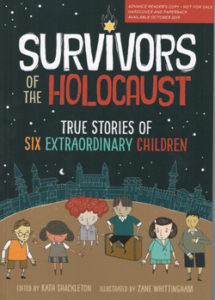
Survivors of the Holocaust: True Stories of Six Extraordinary Children, edited by Keith Shackleton, illustrated by Zane Whittingham; Sourcebooks, © 2019; ISBN pending, 96 pages. By Donald H. Harrison SAN DIEGO –This set of six memoirs, illustrated cartoon style, is intended to make the Holocaust accessible to children ages 10 and up. Today living in

Holocaust survivors remember childhood traumas Read More »

Donald H. Harrison, International, Jewish History