By Shor M. Masori in San Diego

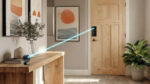
Wi-Charge, an Israeli company using infrared light to send power across a room, has brought its newest wireless charging product to a place most people do not think about until it gets stuck: the front door.
The company’s new $149 wireless power kit for the Schlage Encode and Schlage Encode Plus smart deadbolts replaces the lock’s battery pack with a rechargeable receiver. A small transmitter plugs into a wall outlet inside the house and sends invisible infrared light to the lock, keeping it charged continuously.
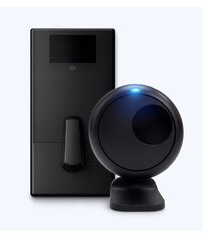
In an interview, Gilad Rotem, vice president of product strategy of Wi-Charge, described the Schlage kit as both a product and a proof point: a way to show larger manufacturers that consumers care enough about battery swaps to pay for a wireless power solution. The Schlage kit is the company’s first direct-to-consumer product. That makes it a test of both the technology and the market. This product may provide the answer to a simple question: will people who already own a popular smart lock pay to stop having to replace its batteries?
The front door is a practical place to ask that question. A phone moves around. Smart glasses move around. A lock stays on the door. If the transmitter has a clear line of sight to the receiver, it can keep feeding power to the same fixed spot.
Wi-Charge was founded in Israel in 2012 by Victor Vaisleib, Ori Mor, and Ortal Alpert. The company has spent more than a decade developing long-range wireless power. In May 2025, it announced a $20 million Series C funding round to expand manufacturing, distribution, and partnerships with device makers.
Rotem said Wi-Charge is proud to be headquartered in Israel. He told me that several people on the team, including Mor, came out of Unit 81, the Israeli military technology unit known for building highly specialized systems for classified operations. Unit 8200 may be the better-known Israeli intelligence unit, but Rotem described Unit 81 as the place where engineers are tasked with building technology that does not yet exist.
He was careful to make a distinction: Wi-Charge did not begin as an army project. The technology was not developed for the military and then turned into a consumer product. The connection is in the people and the problem-solving culture. Rotem described the company as a startup of about 40 people trying to move a difficult technology into everyday use.
Rotem said the larger idea behind Wi-Charge comes from a simple problem: devices keep getting smarter, but batteries are not keeping up with what those devices are being asked to do.
While my Schlage Encode has wifi capabilities, some newer locks include biometric recognition, cameras, facial recognition, palm recognition, or other AI-assisted features. Those features may make devices more useful, but they also draw more power.
That is where Wi-Charge sees its opening. Rotem said the company is looking at the connected home and other devices where charging or battery replacement is a real pain point. The first product had to meet two tests: the price had to make sense, and the battery problem had to be annoying enough that people would pay to solve it.
When I interviewed Ori Mor in 2020, he told me that his team examined different ways to transmit power wirelessly and chose infrared because it could deliver more usable power over a longer distance than radio frequency while allowing a small receiver to fit into consumer devices. In that earlier interview, he also talked about uses ranging from phones and smart home devices to retail displays and commercial automation.
The Schlage kit is one of the first places where that larger ambition becomes approachable. Smart locks are supposed to make life easier. You can open the door with a code, an app, a phone, or a watch. Then the batteries start dying, usually at the worst time.
The kit works with the Schlage Encode Smart WiFi Deadbolt and the Schlage Encode Plus Smart WiFi Deadbolt. It does not support Schlage lever locks. Wi-Charge lists the kit at $149 with free shipping, 30-day returns, a 12-month warranty, and a delivery time of three to four weeks. The company says the transmitter should be placed 3 to 33 feet from the lock, with a clear line of sight. Its listed field of view is 80 degrees.
Wi-Charge sells the product as a retrofit kit. The company’s page notes that Schlage and Schlage Encode are trademarks of Allegion, and that the kit is not manufactured by or affiliated with Schlage.
My installation began with the Schlage deadbolt, which turned out to be more frustrating than expected on my 50-year-old door. The modern Schlage smart deadbolt did not fit the old wooden frame cleanly. The bolt would not fully lock with either the Schlage strike plate or the hardware already on my door. I eventually had to remove the plate and leave the wood crevice exposed so the bolt could fully extend. I also needed a Dremel to get the lock to fit.
But that frustration only came from installing the Schlage lock on an old door. Modern deadbolts assume a more standardized door prep than many older doors have. Rotem told me that the target market likely already has a compatible Schlage Encode installed and working, or at least a door that isn’t twice my age.
Once the Schlage was installed, the Wi-Charge part was a snap, literally. The rechargeable receiver snaps into the same compartment where the Schlage battery pack sits normally and takes up the same amount of space.
Anyone installing both products at the same time must first set up the Schlage lock with its original batteries. The Schlage Encode app’s initial connection requires access to a button inside the lock, and that button is covered once the Wi-Charge receiver is in place. Once the Schlage lock is connected and working, the battery pack can be removed, and the Wi-Charge receiver can be inserted.
The transmitter plugs into a standard electrical outlet and sends invisible infrared light to the receiver on the lock. The kit I tested included a sticky bottom pad and sticky cable holders, which helped keep the cord tidy. The R1 transmitter has a standard ¼-20 tripod thread, so wall mounts and other mounting options can work.
Placement took trial and error. The transmitter has an 80-degree viewing angle, but needs a clear line of sight to the receiver. Once I found the right position, it took a couple of minutes for the signal to find the lock. The light on the transmitter changed from white to blue when it connected and began charging.
After that, the system behaved well. When I waved my hand in front of the transmitter, the beam stopped and reconnected about 3.6 seconds after my hand moved. When I walked along its path, the interruption lasted about 2.5 to 3.5 seconds before the connection returned.
The transmitter makes a slight clicking sound while searching. I only noticed it in a quiet room, and it stopped after a couple of seconds. If the transmitter cannot find the receiver, it searches every few minutes again.
Anything blocking the path interrupts charging. In normal use, that should not matter unless something sits permanently between the transmitter and the lock. The lock still has an internal rechargeable battery.
Rotem said that if the transmitter loses power or line of sight for an extended period, the Wi-Charge receiver should have a standalone runtime comparable to a fresh set of Schlage AA batteries, roughly four to six months, depending on usage.
Safety is the obvious question with any device that sends invisible energy across a room. Rotem said Wi-Charge’s system is a Class 1 laser product, the same general safety class as DVD players, and that the beam shuts off automatically if something obstructs the path. He also said the company has undergone safety and regulatory reviews in the United States, Europe, and Israel. Wi-Charge’s own product page lists worldwide compliance marks including CE, FDA registration, UL recognition, FCC certification, and IECEE compliance.
Rotem said Wi-Charge chose infrared because the company wanted useful power at a useful distance. Radio-frequency power can travel without the same direct line of sight, but it broadcasts energy broadly, so only a small amount reaches the device. That may be enough for tiny sensors. Rotem said it is not enough for a smart lock, camera, or other device with a real duty cycle. Wi-Charge focuses the infrared light as a beam. That gives the system its main advantage and its main limitation: more usable power across a room, but only when the transmitter can see the receiver. (More)
*
Shor M. Masori is a freelance writer with a special interest in Israeli start-ups.
Pingback: Wi-Charge (Continuation from Israeli innovators …) – San Diego Jewish World