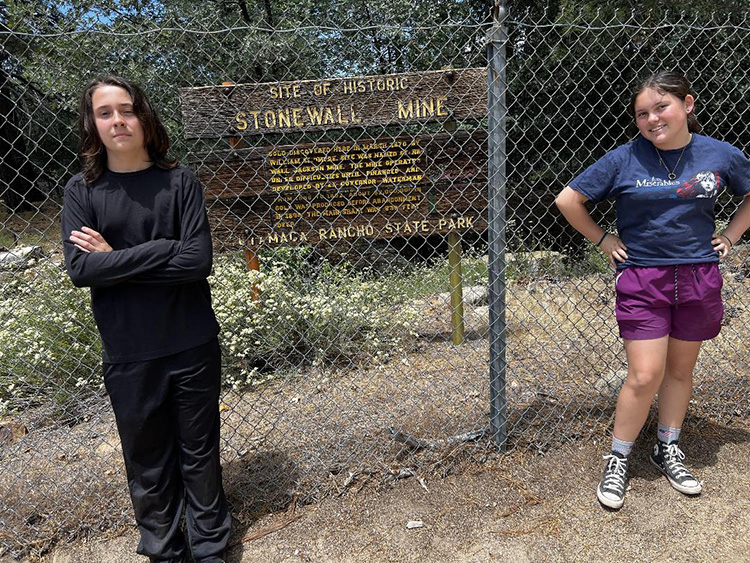
By Cailin Acosta at Lake Cuyamaca, California

While on a staycation trip with the family over Memorial Day weekend at Lake Cuyamaca, we hiked the trails and stumbled across the remnants of the Stonewall Mine, marked as a historical site and owned by the California Department of Parks and Recreation.
An exhibition at the northern end of Cuyamaca Rancho State Park reports that, according to legend, William Skidmore discovered the gold-laden quartz ledge in March of 1870 while chasing one of his 36 mules. Word of the gold spread quickly, and within hours, 500 men were digging near the mine site. Eventually, private investors built and managed a major mining operation at Stonewall. From its discovery to its closure, the Stonewall Mine was undoubtedly the richest gold mine in Southern California. The economic health of the Cuyamaca community periodically flourished or declined depending on the productivity of the mine.
The town of Julian grew rapidly due to the numerous mines located around it. After gold was discovered in Cuyamaca, a legal battle began over ownership of the Julian mines. The grant owners of Cuyamaca Rancho claimed that their boundary extended to include all of the Julian mines. While the Julian miners fought the Cuyamaca grant owners in court, Almon P. Frary operated the mine. His operation ended when he fell into considerable debt after purchasing mining machinery.
In the early mining days, the Cuyamaca Hotel was very lively. Fights among German and Irish immigrants were commonplace events. On one occasion, the mine supervisors purchased a record player in hopes of distracting the miners from fighting during their off-duty hours. The first record played was “It Takes the Irish to Beat the Dutch,” and the record player, the records, and the entire room were destroyed in the fight that followed. By the 1900s, the once-active hotel was quiet and run-down.
Although the exhibit does not report how many of the hundreds of men who worked at the Stonewall Mine were Jewish, about 4,000 Jews flocked to California in search of fortunes. One of the most notable was Levi Strauss, who landed in San Francisco, the major hub of the Gold Rush. Many Jews who made their way west established reliable supply lines for miners, including boots, clothing, hats, and equipment, while others worked as prospectors or engineers in the mines.
Another notable Jewish figure was Louis Rose, documented as the first Jewish settler in San Diego. He arrived in 1850 and became mesmerized by the mining industry. Rose became involved in extracting copper, silver ore, and gold-bearing quartz around San Diego County. Perhaps he even made his way into our local mountains.
The most successful period of operation at Stonewall Mine came under the ownership of Robert Whitney Waterman, who had driven an oxen team from Illinois during the Gold Rush of 1849. Politically active, Waterman played a significant role in the election of Abraham Lincoln and later became Governor of California himself. Newspapers of the time credited Waterman with leading an administration during which California became free of debt. While Waterman owned Stonewall Mine, it produced approximately $2 million in gold, equivalent to more than $60 million today.
According to the exhibit, Governor Waterman could have shipped much of Stonewall’s gold to San Diego by stagecoach from Julian, but he believed doing so would invite robberies. Instead, he sent a light wagon pulled by fast horses and guarded by heavily armed men as a decoy for potential bandits, while the real gold traveled slowly on a heavy freight wagon hidden beneath wood and supplies.
As a further ploy, Waterman would occasionally carry the gold in his own buggy or baggage to San Diego. Once, a train conductor in Lakeside attempted to pick up Mrs. Waterman’s suitcase and found it so heavily laden with gold that he thought it was bolted to the floor. The schemes worked perfectly, as no bandit ever successfully robbed a Waterman gold shipment.
However, what bandits never managed to steal, a local rancher once found lying in the road. A strongbox filled with $10,000 in gold had fallen off a stagecoach traveling from Julian to San Diego and was left behind unnoticed. Fortunately, the rancher was honest, and the gold was recovered. Stories like this may explain Governor Waterman’s reluctance to trust the stage company with his shipments.
When Governor Waterman passed away in the spring of 1892, the Sather Banking Company of San Francisco acquired the Stonewall property. The mill tailings, or discarded ore, were reworked using a cyanide reduction process. The tailings yielded between $3 and $6 per ton, and more than $50,000 was recovered. All reworking operations stopped by 1910.
Under the management of Waldo Waterman, Governor Waterman’s son, the mine continued operating until January 1892, when it closed due to declining ore production and the inability to control flooding in the mine shaft.
The final attempt to operate the mine ended in 1926 when the main shaft caved in. The mine boss and Mike Birdsell were preparing to inspect the timbering inside the shaft when the supper bell rang, so they postponed the inspection until afterward. While eating, they heard a rumble and roar coming from the mine, signaling the end of the Stonewall Mine.
As we hiked back to our campsite, I reflected on such an interesting period in history — the greed of keeping wealth to themselves, the fear of being robbed or killed for precious gold, and the tremendous physical labor required not only from men but also from strong oxen and horses. And to think, all of this happened in our own local mountains.
*
Cailin Acosta is the assistant editor of the San Diego Jewish World.
Enjoyed the history very much thank you so much, Cailin.. I was completely unaware of any of the history up in the Julian area.. One is never too old to learn..