By Cailin Acosta in La Mesa, California

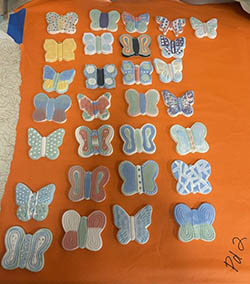
La Mesa Arts Academy’s eighth-grade Social Studies classes, taught by Debra Lunamand and Heather Filippelli, participated in The Butterfly Project just before the end of the school year as students completed testing and finalized semester grades. More than 300 plaster butterflies were painted.
Part of the eighth-grade curriculum includes studying the Holocaust in both English and Social Studies classes. In March, students and teachers traveled to the Museum of Tolerance in Los Angeles, where they spent a day learning about the Holocaust and human rights.
Because Holocaust education is already part of the curriculum, The Butterfly Project served as a hands-on memorial activity rather than an introduction to the subject. In addition, because La Mesa Arts Academy has two kilns on campus for its ceramics program, the butterflies will be fired at the school rather than transported to The Butterfly Project’s location in San Diego’s Kearny Mesa neighborhood.
The Butterfly Project was co-founded in 2006 at San Diego Jewish Academy by educator Jan Landau and artist Cheryl Rattner Price as a hands-on, hopeful, and meaningful approach to Holocaust education. The project collectively memorializes the 1.5 million children murdered during the Holocaust while honoring survivors. To date, 442,902 butterflies have been painted, with the butterflies created at La Mesa Arts Academy adding to that total.
As Lunamand began her second-period Social Studies class, Yiddish music played in the background. Students then learned about individual children whose lives were cut short during the Holocaust.
Children were among the most targeted victims of the Nazi regime because they represented the future of Jewish life and heritage. Each student received a card describing the life of a child and was asked to honor that child by painting a butterfly.
As the plaster butterflies were distributed, students were encouraged to read the accompanying poem and share the story of the child they were memorializing with classmates at their tables.
The butterfly serves as a symbol of hope, rebirth, and remembrance. Through the project, students are encouraged to remember the past while helping ensure such atrocities never happen again.
Lunamand reminded students that the butterflies were not to be taken home. Instead, they would become part of a permanent display at the school. The butterflies will be featured in future remembrance activities and serve as a lasting legacy for generations of students.
When asked what they had learned about the Holocaust, several students shared reflections.
Eisley Schaaf said she had not previously known about the death marches. Having attended Albert Einstein Academies in seventh grade, she had already studied the Holocaust and visited Buchenwald Concentration Camp in Germany. She described the experience as eye-opening and deeply saddening.
Quinn Manglicmot said she was surprised to learn about the different colored badges and symbols used by the Nazis to classify prisoners in concentration camps. She reflected on how confusing and dehumanizing the system must have been for those imprisoned.
Adriel Lopez shared the story of Ester Goldstein, whose family was separated during the Holocaust. Goldstein studied German literature and hoped to leave Europe, but her family was unable to secure passage in time. Her sister Margot survived after being sent to Australia, while other family members were murdered by the Nazis. Ester was only 16 years old when she was killed. Lopez said it was difficult to read about children who were close to his own age and to think about how many never had the opportunity to grow up.
Kelsey Neal reflected on the story of Jadzie Fuchs, who chose not to leave Poland because she did not want to leave her parents behind. Neal said she understood that decision because she would not want to be separated from her own family. She added that learning about the Holocaust in class and visiting the Museum of Tolerance was emotionally difficult because so many people were murdered simply because of who they were.
Alex Acosta reflected on learning about Joseph Landau, whose story is connected to The Butterfly Project through the Landau family. Jan and Sam Landau are two of the founders of The Butterfly Project, and he remembered he talked to Sam at the RUTH: Remember Us The Holocaust exhibit at the San Diego Public Library La Jolla Branch. Sam’s father Max Landau was a survivor, but his uncle Joseph was not. He said it makes him sad thinking of his Jewish heritage and the sacrifice it took to stay alive.
When asked whether she would be an upstander or a bystander, Katie Nguyen said she would choose to be an upstander. She said it is important to speak out against injustice and not remain silent in the face of hatred. Nguyen described the Holocaust as a tragic period in history and said it was difficult to believe such events occurred.
Through art, remembrance, and education, The Butterfly Project encourages students to honor the lives of Holocaust victims while carrying forward the lessons of history.
The poem shared was written by Pavel Friedmann who was a prisoner at Theresienstadt Concentration Camp. Lunamand explained to the class that this camp was an example of what was to be presented to the Red Cross and that families were flourishing and there were no issues of concern. Children were given cookies and many musicians were prisoners so would perform showing what a wonderful environment they were in. When the Red Cross left, children and families were sent to Auschwitz, to their death.
*
The Butterfly by Pavel Friedmann, Theresienstadt, June 4, 1942:
He was the last. Truly the last.
Such yellowness was bitter and blinding
Like the sun’s tear shattered on stone.
That was his true colour.
And how easily he climbed, and how high,
Certainly, climbing, he wanted
To kiss the last of my world.
I have been here seven weeks.
“Ghettoized”.
Who loved me have found me.
Daisies call me.
And the branches also of the white chestnut in the yard,
But I haven’t seen a butterfly here,
That last one was the last one.
There are no butterflies, here, in the ghetto.
*
Click here to learn more about The Butterfly Project.
*
Cailin Acosta is the assistant editor of the San Diego Jewish World.