By Alex Gordon in Haifa, Israel
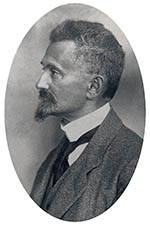
The outstanding German mathematician Felix Hausdorff was born on November 8, 1868, in Breslau into a Jewish merchant family. His father was a wealthy textile merchant, and the family never experienced financial difficulties.
In 1870, the father moved the family to Leipzig, where he was involved in textile manufacturing and published several treatises and Talmudic commentaries. At school Felix had wide interests and, in addition to mathematics, he was attracted to literature and music. In fact, he wanted to pursue a career in music as a composer, but his parents put pressure on him to give up the idea of becoming a composer.
In 1891, Hausdorff defended his doctoral dissertation at Leipzig University. Since 1895, he has been an associate professor, and since 1902, a professor at this university. From 1910 to 1912 and from 1921 to 1935, he was a professor at the University of Bonn, and from 1913 to 1921, he was a professor at the University of Greifswald.
Until the age of 34, Hausdorff, alongside mathematics, was also interested in astronomy, as well as literature and philosophy. During this period, he (under the pseudonym Paul Mongré – the name Mongré is a phonetic play on the French expression “à mon gré,” which translates to “to my taste,” “at my discretion,” or “as I please”) published two books of poetry and aphorisms, the philosophical treatise Chaos and Cosmic Choice (1898), a collection of philosophical and literary essays, and in 1904, the highly successful farce The King’s Doctor.
Hausdorff led a double life. For the academic community, he was the strict, precise German mathematics professor Felix Hausdorff. As Mongré, he could afford to be ironic, sharp, write love lyrics, and criticize established social dogmas. Until the beginning of the 20th century, many of his fellow mathematicians were even unaware that their colleague Hausdorff and the popular Berlin playwright and philosopher Mongré were the same person.
In 1914, his famous book Foundations of Set Theory was published. In set theory, Hausdorff solved the problem of the cardinality of Borel sets, developed measure theory (Hausdorff measure) in multi-dimensional spaces, and developed the theory of ordered sets. In functional analysis, Hausdorff is credited with the theory of abstract spaces. He is the founder of general topology and the general theory of metric spaces. Fundamental results were also obtained by Hausdorff in mathematical analysis, group theory, and number theory.
In 1933, the Nazis came to power in Germany, and the German government issued the Civil Service Law. The idea of this law was simple: “Aryan students should be taught by Aryan professors.” Teachers in Germany were civil servants, All Jews who taught at German universities were dismissed. But Hausdorff remained employed, as the new law made an exception for Jews who had served in the army during World War I. An exception was made for Hausdorff, who had served as a volunteer in the infantry, and he remained a professor in Bonn until he retired due to age in March 1935. After retiring, Hausdorff was effectively expelled from the University of Bonn by the Nazi authorities, but even after that, he continued to work actively, mainly on problems in the theory of Lie groups and set theory. During these years, his scientific articles were published only outside of Germany.
In October 1941, Hausdorff and his wife were forced to wear yellow Stars of David – a mark of outcasts, and by the end of the year, they received news that they would be deported to Cologne: this was the beginning of their transport to the concentration camps that the Nazis had built in Poland. In January 1942, Hausdorff learned about the impending inevitable deportation of his family to a concentration camp. A letter has been preserved, which Hausdorff wrote on Sunday, January 25, 1942. In it, he wrote: “By the time you receive these lines, […] we will have resolved our problem, although you have tirelessly tried to dissuade us from this […] What has been done against the Jews in recent months has filled us with terrible grief, because it has led to an unbearable situation […] Forgive our desertion! We wish you and all our friends a better future.”
On the night of Sunday, January 25, 1942, Hausdorff, along with his wife Charlotte and her sister Edith, took a lethal dose of sleeping pills. By the morning of January 26, they were dead. Their remains were cremated, and the ashes were buried at the Poppelsdorf Cemetery in Bonn.
Felix Hausdorff is a unique phenomenon in the history of science. As a mathematician, he played an important role in the formation and development of modern mathematics in the 20th century. He founded general topology as an independent mathematical discipline, enriching set theory with several fundamental concepts and results. His general approach to measurement and dimension has led to profound developments in numerous mathematical disciplines, and today Hausdorff dimension plays a central role in fractal theory. The remarkable mathematical versatility of Hausdorff is reflected in his published works: today, no fewer than thirteen concepts, theorems, and procedures bear his name.
However, he was not only a creative mathematician but also an original philosopher, thinker, poet, essayist, and writer. Under the pseudonym Paul Mongré, he published a volume of aphorisms, an epistemological study, a book of poetry, a frequently staged play, and several notable essays in leading literary journals.
The life of Felix Hausdorff is a profound story of duality: he was a brilliant German scientist and writer. But alongside this duality, there existed a Jewish-German duality: Hausdorff was German by culture and Jewish by blood. He considered German science and culture his own, belonged to the highest academic elite of Germany, but the forces ruling German society saw in him, a brilliant scientist, an inferior outsider doomed to destruction.
Throughout his life, Hausdorff felt himself to be a part of the German intellectual elite, a true patriot of German culture, which was typical for many assimilated German Jews of that time. After the Night of Broken Glass in 1938, he fell into a terrifying isolation, from the elite to the bottom of society, and found “salvation” from Nazi persecution in suicide.
*
Alex Gordon is professor emeritus of physics at the University of Haifa and at Oranim, the Academic College of Education. He is the author of 12 books.