By Alex Gordon in Haifa, Israel
Albert Einstein began working in Berlin in April 1914. He moved from Switzerland to work at the Kaiser Wilhelm Institute of Physics and to become a member of the Prussian Academy of Sciences. In 1917, Einstein became director of this institute (now the Max Planck Institute for Physics), which was in the Dahlem district.
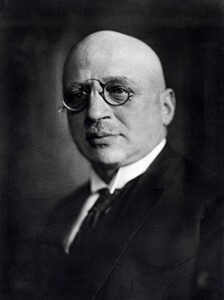
He was also a professor in the Department of Physics at Humboldt University of Berlin. At the institute, he met Fritz Haber, director of the Kaiser Wilhelm Institute for Physical Chemistry and Electrochemistry, a professor at the same Humboldt University of Berlin, a privy councilor, a baptized Jew, and a great patriot of the German Empire.
According to Nobel Prize in Physics laureate James Franck, a German scientist of Jewish descent who knew Haber well, Haber was a fun-loving, cheerful man, brimming with humor and rare erudition; an avid traveler; impulsive; passionate, quick-thinking, an excellent lecturer, a man of brilliant intellect, ambitious, and a superb conversationalist—he could hold a conversation on any topic.
Einstein and Haber became close friends. Fritz acted as a diplomatic mediator during Einstein’s difficult divorce proceedings with his first wife, Mileva Marić. Mileva lived with the couple’s children at Haber’s home until she left for Switzerland.
Before World War I, Haber devised a method for synthesizing ammonia from hydrogen and atmospheric air under high pressure. By oxidizing the ammonia obtained from the air, nitric acid, fertilizers, and explosives were produced. For this invention, he was awarded the Nobel Prize in Chemistry in 1918.
In August 1914, the war began, along with the naval blockade of Germany. Military experts of the Entente believed that without saltpeter—of which Germany had no deposits—the Germans would be unable to produce nitric acid. This would halt the production of explosives and gunpowder, shut down munitions factories, and leave the Germans without cartridges and shells, since nitrates are an essential component of explosives. Within six months, Germany would have suffered a military collapse. But thanks to Haber’s discovery, Germany never experienced a shortage of ammunition throughout the entire war. Haber was a staunch German patriot and supporter of the empire.
On the eve of the war, Haber conducted tests on chemical weapons using animal experiments to develop chemical weapons designed to kill people. Haber’s distinguished colleague at the University of Berlin, Nobel Prize laureate in Chemistry, and German patriot Emil Fischer opposed his colleague’s lethal experiments. He declared that “from the bottom of my patriotic heart, I wish you failure.”
In the spring of 1915, the Germans, under Haber’s leadership, began using the poison gases he had developed against French soldiers. His team included more than 150 scientists and approximately 1,300 engineers and technicians. Among them were two Nobel laureates of Jewish descent: physicist James Franck and chemist Richard Willstätter. On April 22, 1915, Haber used a poison gas—chlorine—for the first time against French soldiers near the small Belgian town of Ypres: according to German reports, 5,000 were suffocated on the spot and 10,000 were incapacitated and left disabled. Haber explained to his colleagues that poison gases were a humane weapon, as they offered a real prospect of a swift end to the war.
Einstein was a pacifist and an opponent of German nationalism and imperialism. In this sense, Haber was his complete opposite. Shortly after Einstein’s arrival in Berlin, Haber tried to persuade him to be baptized “so that you might belong to us completely and wholly.” Einstein replied that the “we” to which Haber considered himself to belong was a fiction. Despite their friendship, Einstein was always bluntly candid whenever he heard about Haber’s Christian beliefs. He considered him a “pitiful man, a baptized Jewish privy councilor.” After Haber’s death, Einstein recalled his futile efforts to have him baptized: “I never felt any respect or sympathy for Germany, which he loved so hopelessly.”
Since Haber had served in the German military during World War I, the Nazis made an exception for him: he was not dismissed from his position under the new law requiring the dismissal of Jews from academic and government institutions. However, in April 1933, he refused to dismiss the Jews from his staff and sent a letter of resignation to the Ministry of Art, Science, and Public Education, which included the following lines: “For more than forty years of service, I have selected my staff based on their intellectual development and character, not on the basis of their grandmothers’ origins, and I do not wish to change this principle in the final years of my life.” His resignation is dated May 2, 1933. After resigning, he left for England.
In the summer of 1933, in Cambridge, chemist Chaim Weizmann—the future president of Israel—offered Haber a position as head of the physical chemistry department at the Daniel Ziv Institute in Rehovot, which would later become the Weizmann Institute. Haber accepted the invitation. When Einstein learned of Haber’s decision to move to Palestine, he wrote to Fritz: “I was pleased to learn that your love for the blond beast has cooled.” Almost with malice, he added: “Who would have thought that my dear Haber would become a champion of the Jewish and Palestinian cause.”
Haber never made it: on his way from England to Palestine, while on vacation in Basel before meeting his son Hermann, he died of a heart attack on January 29, 1934. Fritz Haber, a German patriot, died in exile on his way to the land where the Jewish people lived—the very people he had renounced his entire life. Haber’s connection with the German people never materialized, for it was his most unsuccessful invention. In a letter of condolence that Albert Einstein wrote to Haber’s family upon learning of his death, there are these lines: “His tragedy is the tragedy of a German Jew, the tragedy of an unrequited love for his homeland.”
What was the basis of Haber and Einstein’s friendship? Both were born into non-religious, assimilated, middle-class Jewish families. Both were great scientists, devoted to science. Haber’s baptism was a pragmatic decision. He did not become religious. He was a secular man, a typical assimilated middle-class Jew, just like Einstein. But there were significant differences between them. Haber loved titles and ranks, preferring to be addressed as “Your Excellency, Mr. Privy Councilor.”
Einstein reacted to his first serious academic appointment by remarking that he was now an “official member of the guild of prostitutes.” Haber served a year in the army. Einstein evaded service in the German army by leaving for Switzerland at the age of sixteen. He despised Germany’s disciplined, orderly, militarized society, criticizing its “foolish belief in authority.” Haber was a natural product of that society.
On October 4, 1914. Haber, Ehrlich, and Wilstätter—three Jewish Nobel laureates in chemistry—signed Manifesto 93, addressed by German intellectuals to the “cultural world,” proclaiming Germany’s innocence regarding the outbreak of the war and denying the atrocities committed in Belgium. They supported the German Empire’s war machine. Einstein opposed this “madness,” feeling “pity and revulsion”; “all our much-vaunted technological progress and civilization as a whole can be compared to an axe in the hands of a pathological criminal.”
Antisemitism was a constant backdrop in Germany at that time. Einstein recalled: “When I arrived in Germany, I learned for the first time that I was a Jew, and I owe this discovery more to the Germans than to the Jews.”
On March 28, 1933, Einstein submitted his resignation from the Prussian Academy of Sciences due to the Nazis’ rise to power in Germany. The Academy was horrified by his statement that he would not return to Germany because its new government did not recognize individual rights and equality before the law. The Academy was in an uproar over his agitation abroad. A resolution was being drafted stating, “We have no reason to regret Einstein’s resignation.”
Einstein’s old friend Max von Laue, a Nobel laureate in physics, was horrified at the thought that the Academy might issue such a document and spoke out against it at its special meeting on April 6. None of the 14 members present supported him. Even Haber, a close friend of Einstein’s, voted with the majority.
Einstein was captivated by Haber’s personality, his charisma, wit, and erudition. Fritz was his kind and reliable friend, prone to reflection, self-analysis, and depression. Haber’s rich inner world was a precious gift in Einstein’s life. They often met for a cup of coffee. Einstein forgave Haber for his militarism, German nationalism, and the cynicism of an atheist who had converted from Judaism to Christianity.
He, a pacifist, did not forgive others for sins far less serious than Haber’s war crimes. The most striking example was his attitude toward the military service of the outstanding German astrophysicist of Jewish descent, Karl Schwarzschild, a member of the Prussian Academy of Sciences who had derived the first exact solution to the equations of the general theory of relativity.
Immediately after the outbreak of World War I, Schwarzschild voluntarily enlisted in the army even though he was beyond the draft age—he was 40 years old. He served as an artillery lieutenant and calculated the trajectories of shells containing mustard gas manufactured by the German Army’s chemical service, headed by Haber. The primary blame for the creation and first-ever use of chemical weapons lay with him, not with Schwarzschild, who died from the effects of a gas attack on May 11, 1916, at the age of 42.
Einstein wrote an impressive and touching obituary, but on the day of Schwarzschild’s funeral, he wrote to his close friend, the Swiss engineer of Jewish descent Michele Besso: “Schwarzschild is a true loss. He would have been a true gem had he been as decent as he was intelligent.” He could not forgive the militarist Schwarzschild even a fraction of what he forgave the war criminal Haber. The only thing he could not forgive his friend for was his attitude toward Jews—an attitude the friend had repented of shortly before his death in a conversation with Chaim Weizmann: “In my twilight years, I see myself as a bankrupt person.”
*
Alex Gordon is professor emeritus of physics at the University of Haifa and at Oranim, the Academic College of Education. He is the author of 12 books.