Previous story: Shanghai Jewish memories: 2 community members relate families’ stories – San Diego Jewish World
By Cailin Acosta in San Diego

When Nazi Germany annexed Austria in March 1938, thousands of Jewish families faced an urgent question: Where could they go? Countries around the world acknowledged the danger facing European Jews, but immigration restrictions made it difficult for refugees to find countries willing to accept them. Shanghai, a Chinese port city unfamiliar to many Europeans, became an unlikely refuge.
Members of Tifereth Israel Synagogue’s Sisterhood recently attended a docent-led tour of Shanghai, Homeland Once Upon a Time: Jewish Refugees and Shanghai at the San Diego Chinese Historical Museum. Created in collaboration with the Shanghai Jewish Refugees Museum, the Chinese American GI Project and the local community, the exhibition explores the journeys of Jewish refugees to Shanghai and their lives during and after World War II.
One of the exhibition’s central stories is that of Chinese diplomat Ho Feng-Shan, who served as Chinese consul general in Vienna. As Jews desperately sought ways to escape Nazi-controlled Europe, Feng-Shan issued visas to Shanghai to refugees who otherwise might have been unable to leave. The visas became known as “visas for life.”
For many refugees, Shanghai was not necessarily their intended destination. They simply knew that having a visa could provide a way out of Austria. Some eventually traveled elsewhere, including the United States.
An exhibit passport belonging to Kurt Sax illustrates this unusual journey. The document bears the “J” designation used to identify Jewish holders of German passports and contains a Shanghai visa issued by the Chinese consulate in 1939. Sax ultimately did not settle in Shanghai, but used the visa to leave Vienna and eventually reach the United States.
Refugees reached Shanghai by several routes. Some traveled by ship from European ports, while others traveled overland through Siberia to northeastern China. Harbin, home to an established Jewish community, became an important stop for some refugees before they continued south to Shanghai.
The outbreak of the Pacific War brought an end to the flow of refugees. After the Japanese attack on Pearl Harbor on Dec. 7, 1941, travel and financial connections between the United States and Japanese-controlled Shanghai were severely disrupted. By that time, more than 20,000 Jewish refugees had arrived in Shanghai. The Shanghai Jewish Refugees Museum documents the history of this community and preserves artifacts including passports, ship tickets, residence permits and other personal materials. Its memorial wall bears the names of thousands of refugees.
For refugees who remained in Shanghai, survival often meant rebuilding an entire community under extremely difficult circumstances. Many were concentrated in Hongkou, where the Japanese established a restricted area for stateless Jewish refugees. Crowded living conditions and limited resources made daily life challenging.
Food was particularly difficult to obtain. A soup kitchen provided one meal a day, helping refugees survive amid shortages. The American Jewish Joint Distribution Committee initially provided financial assistance, but that support was interrupted after Pearl Harbor. Laura Margolis, who was involved in assisting the refugees, refused to let the loss of funding stop her work. She approached Jewish-owned banks and wealthy members of Shanghai’s established Jewish community to borrow money to purchase food. For months, those loans helped keep the soup kitchen operating. Her efforts illustrate the importance of cooperation between Shanghai’s established Jewish community and the newly arrived refugees.
Chinese residents also played a role in helping their Jewish neighbors. People living near the restricted area developed relationships with refugees and sometimes helped them establish connections outside the ghetto, allowing them to find small business opportunities and other ways to earn money. These relationships between Jewish refugees and Chinese residents became an important part of the community’s history. The San Diego exhibition highlights the ways the two communities interacted and supported one another.
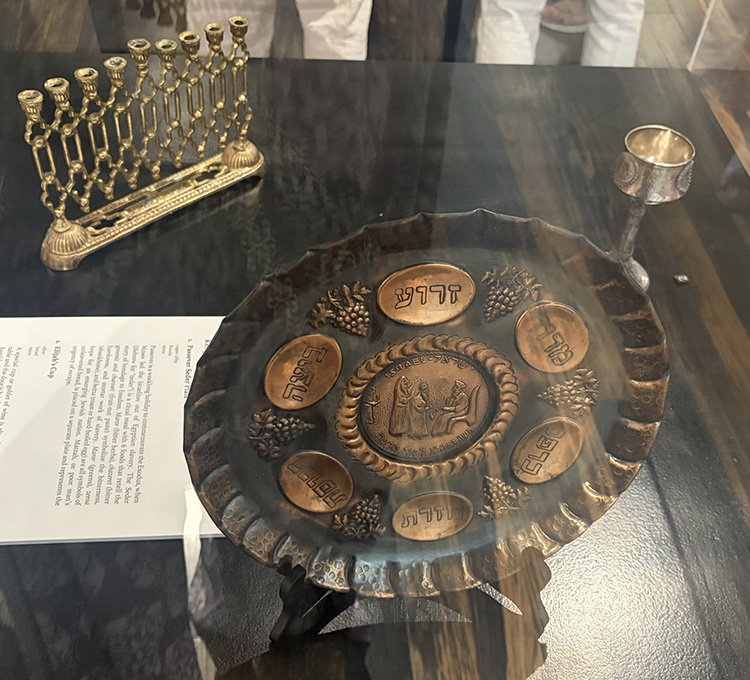
Despite the hardships, the refugees worked to preserve the lives and traditions they had left behind in Europe. They established schools, newspapers and journals. Weddings and religious life continued. Families who had managed to bring prayer books and other ritual objects carried those traditions with them into their new surroundings.
Among the objects displayed in San Diego is a collection of Jewish religious materials that survived the journey from Europe to China. Other personal artifacts include photographs, documents and scrapbooks that provide glimpses into the everyday lives of refugees.
One scrapbook belonged to Ursula Conser, who arrived in Shanghai in her early 20s. She and a friend lived there together and documented their experiences. Her scrapbook contains photographs and handwritten notes describing life in Shanghai. It also preserves a remarkable love story. After Pearl Harbor, an American ship was detained by the Japanese. Conser fell in love with the ship’s captain. Although the ship eventually left Shanghai, the two continued communicating. She later made her way to the United States, where they married.
For the museum, such personal stories are as important as the larger historical events. The fragile scrapbook is now being digitally preserved so that its photographs and handwritten memories can survive for future generations.
For many refugees, the end of World War II brought another emotional challenge. While living in Shanghai, many had been unaware of the full extent of the Holocaust taking place in Europe. After the war ended in 1945, news began arriving about the destruction of European Jewish communities and lists of survivors. Refugees searched those lists for the names of relatives and friends. The museum includes photographs depicting survivors in Shanghai searching through lists of Holocaust survivors in 1946. The images capture the uncertainty of families who did not yet know who had survived.
Some refugees eventually returned to Europe. Others immigrated to the United States, Israel, Canada, Australia and South America. Still others returned to Shanghai decades later. One former refugee who became a successful American businessman returned to China after the country began opening to foreign investment in the late 1970s and early 1980s. He became one of the early foreign investors in Shanghai and helped establish business connections between the United States and China.
Another former refugee, W. Michael Blumenthal, went on to become U.S. Treasury secretary under President Jimmy Carter and returned to China numerous times, including several visits to Shanghai. Their later experiences demonstrate how a place that had once been a refuge from persecution became, decades later, a setting for renewed cultural and economic relationships.
One of the most powerful elements of the exhibition is its emphasis on individual names. Sonja Mühlberger, born in Shanghai’s ghetto as a child, later became determined to document the people who had lived there. She began collecting the names of Jewish refugees through community networks. Her efforts eventually contributed to the creation of a memorial wall listing thousands of people who had lived in Shanghai during the war. The list continues to grow as families around the world provide additional information. The Shanghai Jewish Refugees Museum reports that its memorial wall contains 18,578 names, while its collection continues to document the experiences of the refugees and their descendants.
The stories behind those names are remarkably personal. One woman who arrived in Shanghai as a young child remembered that her family could not afford a birthday cake. Instead, her parents gave her a sweet potato. Decades later, when she returned to Shanghai, she found a sweet potato and held it as a reminder of that childhood birthday. For her, the simple object represented an entire chapter of her life.
The San Diego exhibition brings these individual memories together to tell a larger story, of escape, survival, community and rebuilding. The refugees who arrived in Shanghai came from different backgrounds and had different experiences. Some were wealthy before the war. Others arrived with almost nothing. Some remained in Shanghai for years; others used the city as a temporary refuge before continuing to another country. What they shared was the need to build new lives in an unfamiliar place.
The exhibition also demonstrates the importance of preserving personal documents. Passports, photographs, letters, scrapbooks and religious objects can transform a broad historical event into a collection of individual stories. The exhibition was developed in collaboration with the Shanghai Jewish Refugees Museum after museum representatives connected with the San Diego Chinese Historical Museum. Materials from the Shanghai museum were adapted for the San Diego display and supplemented by objects from local collections.
The result is a history told not only through dates and statistics, but through the people who lived it. For the refugees who escaped to Shanghai, survival meant finding food, creating schools, maintaining religious traditions, making friendships and rebuilding families. For their descendants, preserving those memories ensures that the names, and the individual lives behind them, are not forgotten.
Shanghai was an unlikely refuge during one of history’s darkest periods. For more than 20,000 Jewish refugees, it became a temporary home, a place of hardship and, ultimately, a place where they survived. Their stories remain a powerful reminder that even in times of persecution and displacement, communities can find ways to preserve their identity, help one another and begin again.
Click here to search for names of Shanghai refugees.
Click here to learn more about the San Diego Chinese Historical Museum. The exhibit will be open through Sunday, January 3, 2027.
*
Cailin Acosta is the assistant editor of the San Diego Jewish World.