By Andreas Albrecht in Cologne, Germany
I am not writing as a historian. I am writing because I want to remember. I am putting my thoughts and feelings into words in the hope of reaching people who are willing to look closely. So that what happened in the past does not remain distant, abstract or forgotten.
It began with a badge issued by the Ancre Somme Association Charity, distributed through the Empire Poppy Store, for the 85th anniversary of the Babyn Yar (Babi Yar) massacre. A small badge intended to make remembrance visible. For me, that is exactly what it did.
It did not remain just an object. It became a question that would not leave me:
What do I really know about this place?
Babyn Yar.
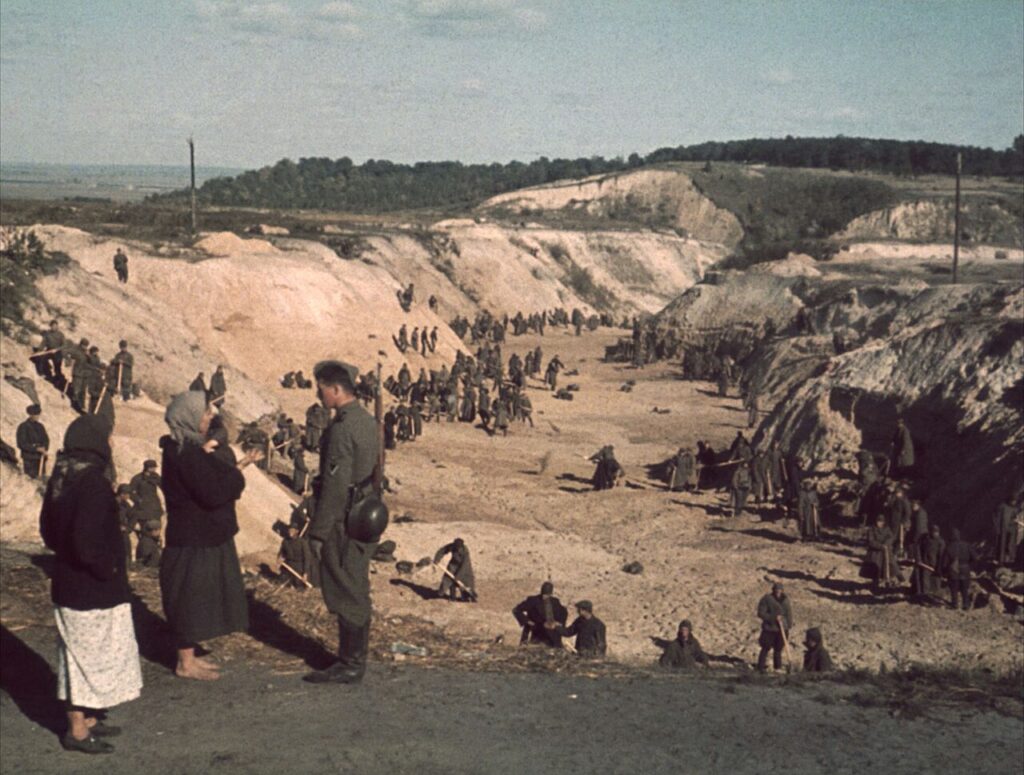
A ravine near Kyiv. A place where German perpetrators murdered around 34,000 Jewish people in just two days, on 29 and 30 September 1941.
The German Einsatzgruppen report records 33,771 people murdered over those two days. That figure comes from the perpetrators’ own records and suggests a degree of precision that cannot capture the reality of the killing down to every individual victim. It is therefore more appropriate to speak of around 34,000 people murdered.
But even that number refers only to the major massacre of 29 and 30 September 1941. The killing at Babyn Yar continued throughout the entire period of German occupation. In total, an estimated 40,000 to 50,000 Jewish people were murdered there.
These numbers must be stated. They show the scale of the crime. But remembrance cannot stop at them.
Before Babyn Yar became a place of death, Kyiv was a city with a vibrant Jewish life. Jewish people lived in Kyiv, worked there, studied, loved and cared for their families. They had homes, professions, memories and plans.
Yet even before the German occupation, Jewish life in the Soviet Union was subject to severe state restrictions. Many synagogues had been closed. During the 1930s, Jewish cultural and educational institutions were increasingly curtailed; the network of Yiddish-language schools also shrank sharply.
Despite these restrictions, Kyiv remained an important center of Jewish life. Jewish people were part of the fabric of the city – as neighbors, friends, relatives, colleagues and classmates. Their lives belonged to this city and to the history of Ukraine.
Before they became victims, they were fellow citizens – part of the shared life of this city.
Behind the numbers were people with very different life stories and circumstances. Children and young people, adults and elderly people. They studied, worked, started families, loved, argued, worried, hoped and made plans. Their everyday lives were shaped as much by the political and social conditions of their time as by personal experiences, worries and hopes.
At Babyn Yar, it was not only people who were murdered. Relationships were torn apart, families were destroyed and futures were taken away.
I cannot tell the stories of all the victims. I have read some of their names at Yad Vashem. I would like to focus on two of them – not because they can speak for everyone, but because, through them and with the greatest respect, I want to remember all the victims.
Pola Perlovitz was born in Kyiv in 1924. She was a schoolgirl and was only 17 years old.
My daughter Elena is 18 today – almost exactly the age Pola was when she was murdered. Elena is full of joy and plans for the future. When I look at her, the number 17 becomes even more real to me.
We do not know what Pola dreamed of or what plans she had. At 17, her whole life should still have been ahead of her. Instead, she was brutally murdered at Babyn Yar.
Many years later, her former classmate Maria Kolominskaya remembered Pola and submitted a Page of Testimony for her to Yad Vashem. In this way, Pola’s name was preserved – and with it the memory of a 17-year-old girl whose life was extinguished at Babyn Yar.
I am deeply grateful to Maria Kolominskaya for this commitment to remembrance. It is through people like her that we can still learn the names behind the numbers – and that every one of those names belongs to a human being, a life and a story.
Mariya Rubchinskaya was born in 1935, lived in Kyiv and was only six years old. Her mother, Sofiya Rubchinskaya, née Livshitz, was 43 years old and a dentist. On 29 September 1941, mother and daughter were murdered at Babyn Yar.
At six, Mariya should have been playing, learning and growing up. Her life had only just begun when all possibility of a future was taken from her.
Mariya’s brother Abram survived. Later, he submitted Pages of Testimony to Yad Vashem for his sister Mariya and his mother Sofiya. Through his remembrance, their names were preserved as well.
So today we know more than the fact that among those murdered were a six-year-old girl and her mother. We know their names: Mariya and Sofiya Rubchinskaya. And we know that there was a brother and a son who refused to let them be forgotten.
At this point, I would like to pause for a brief moment and bow my head in prayer in memory of Pola, Mariya, Sofiya and all the victims of Babyn Yar. Perhaps you too would like to pause for a moment – in prayer, in silent thought, or simply in remembrance of the people whose lives were extinguished here.
After this moment of reflection, we must turn again to the crime itself.
Babyn Yar was not a spontaneous outbreak of violence. The mass murder was planned, organized and ordered. At the end of September 1941, German authorities decided to murder Kyiv’s Jewish population. On 27 and 28 September, notices were posted in Kyiv. Jewish residents were ordered to assemble the following morning and to bring documents and personal belongings with them.
The German perpetrators spread the rumor that the Jewish population was to be resettled. Dina Levina, still a girl at the time, later remembered that neighbors asked her to question a German guard about where they were being taken because she knew some German. He told her that they would be taken away and should not be afraid. Some believed or hoped that they were going to be resettled. Others feared the worst. But they were under orders and under threat of death. Anyone who failed to appear was to be shot. Many came with children, elderly relatives and sick family members – with people they could not simply leave behind.
On the way to the ravine, German forces and, in some cases, local auxiliaries were involved in guarding and driving the people onward. From a certain point, there was no turning back.
Raisa Dashkevich, born in 1916 and one of the survivors of Babyn Yar, later remembered how Germans formed a corridor through which the people were driven. She herself was carrying her son in her arms. People were beaten with whips, and anyone who tried to step aside was driven back with dogs. Raisa tried to shield her child with her own body so that the blows would fall on her rather than on him.
The people were driven onward. They had to put down their personal belongings and documents. Then came forced undressing, further beatings, fear – and finally the shootings.
Raisa survived. When she regained consciousness beneath the bodies during the night, her son was still with her. He was already dead. In her recollection, he had not been killed by a bullet but had suffocated under the weight of the bodies lying on top of her.
David Aizenberg also survived Babyn Yar. When he saw the horror before him at the edge of the ravine, he lost consciousness and fell into the ravine before he was shot. He regained consciousness beneath the bodies. Germans shot wounded people who still showed signs of life. When a German stepped on his legs, David bit his finger to keep himself from making a sound. In the end, he too was able to leave Babyn Yar alive.
The horror of Babyn Yar must be named, however hard it is to bear. The exact sequence of the shootings varied in detail. But the aim was the same: the systematic murder of Jewish people.
Our remembrance must preserve more than a number: the names of those murdered, their faces and their dignity – and it must name responsibility clearly.
Babyn Yar was a German crime. At its center stood Sonderkommando 4a of Einsatzgruppe C under Paul Blobel, supported by other German police and occupation units. Members of the local auxiliary police and other local helpers were also involved; there were informers and people who profited from persecution and dispossession. That too is part of the truth.
But it does not change the central fact: the aim was the annihilation of Kyiv’s Jewish population. The decision to murder them, and the organization and execution of the mass murder, were under German command. The murders at Babyn Yar were part of Germany’s war of annihilation in the East and an expression of National Socialism’s antisemitic determination to annihilate Jewish people.
The killing did not end on 30 September 1941. Jewish people who had escaped the first massacre and were later discovered were also taken to Babyn Yar and murdered. Until 1943, German perpetrators continued to use the ravine as a killing site. Among the other victims were patients from a psychiatric hospital, Roma, Soviet prisoners of war and non-Jewish civilians.
Few places shape our memory of the Shoah as powerfully as Auschwitz. But the Shoah did not take place only behind camp gates. It also happened in the open air – in ravines and forests, at the edges of pits, in fields and often in the immediate vicinity of the places where people had previously lived.
Babyn Yar did not mark the beginning of the mass shootings of Jewish people during the Shoah. The killing had already begun. But here, within only a few days, it reached an early and horrifying peak.
At least one and a half million Jewish people were murdered on the territory of present-day Ukraine. Many of them were not deported to distant camps but were shot close to their own towns and villages. Their graves lay in places where grass later grew again, paths ran and people went about their everyday lives.
Yet the perpetrators denied even the dead peace and dignity.
In 1943, they forced prisoners from the Syrets camp to reopen the mass graves at Babyn Yar. The bodies of those murdered were exhumed and burned, their bones crushed, their ashes and remains scattered.
This was part of the so-called Aktion 1005. The National Socialists wanted to erase the traces of their mass crimes and destroy all evidence of them. What remained of those they had murdered was to be destroyed as completely as possible.
No visible graves. No evidence. As little as possible that might remind anyone of those who had been murdered.
The prisoners forced to carry out this work were also to be murdered afterwards. Most of them were indeed killed. A small number, however, managed to escape. They survived and later testified to what the perpetrators had tried to conceal at Babyn Yar.
But people remembered the mass murder at Babyn Yar.
Survivors such as Dina Levina, Raisa Dashkevich and David Aizenberg later spoke about what they had experienced at Babyn Yar. Their testimonies preserved not only knowledge of the crime, but also the voices of those who had managed to escape it. Relatives and friends preserved names and memories. People such as Maria Kolominskaya and Abram Rubchinski completed Pages of Testimony. Historians reconstructed individual lives and the course of the crimes.
In this way, names, stories and traces of lives could be preserved – and with them the reminder that behind every name stood a human being and a life. And so there remains the hope that they will never be forgotten.
After the war, a new and difficult chapter in the history of Babyn Yar began: how the site would be treated and how those murdered there would be remembered.
In official Soviet commemoration, those murdered were primarily described as Soviet citizens and victims of fascism. The Jewish victims of the main massacre and the antisemitic nature of their murder were not at the center of official state remembrance. The Soviet monument erected in 1976 likewise did not explicitly identify the victims as Jewish.
That does not mean that their Jewish identity was unknown or that people did not remember them. During glasnost and perestroika, public commemoration of Babyn Yar began to change. The Jewish victims and the antisemitic character of the crime could increasingly be named more explicitly. This change continued as the Soviet Union disintegrated.
On 29 September 1991, the 50th anniversary of the beginning of the massacre, the Menorah Monument was unveiled at Babyn Yar in memory of the Jewish people who had been murdered there.
Babyn Yar itself was also profoundly altered in the decades after the war. Parts of the ravine were filled in, roads were built and areas were turned into parkland. Much of what had shaped this place in 1941 is no longer immediately visible today.
But the transformation of the site must not allow the crime, or those who were murdered there, to be forgotten.
Babyn Yar is one of the central sites of the Shoah in Eastern Europe and one of the most significant sites of mass shootings of Jewish people. Here, German perpetrators murdered tens of thousands of Jewish people from Kyiv. This crime is part of German history – and remembering it is our obligation and our responsibility.
Babyn Yar must be taught in schools as a mandatory and integral part of education about the Shoah.
Children and young people need to learn what happened there. But the history of Jewish life must not begin only with its destruction. Teaching must also show how Jewish people lived before the persecution, the place they held in their towns and communities, in culture and in the lives of the people around them, and what was lost when they were murdered.
This knowledge must also include the mass shootings in which Jewish people were torn from their everyday lives and often murdered only a few kilometers from their homes – in forests, fields, at pits and in ravines.
Anyone who wants to understand the Shoah must also understand this form of annihilation – Babyn Yar and the many other places where Jewish people were murdered in their own homeland.
And then there is the present.
Across Ukraine lie many known and still unknown Jewish mass graves – places where victims of the Shoah were shot and buried without names on gravestones and without a dignified burial.
Today, people in Ukraine are once again being murdered and tortured. Bodies have been found in mass graves and unmarked graves. Russia has attacked Ukraine and is waging a war that continues to claim countless victims. Bucha and Izium have come to stand for crimes that have been seared deeply into the history and the soul of this country and its people.
Places of remembrance are also under threat. Memorial sites, Jewish cemeteries and both visible and hidden traces of the Shoah can be damaged or destroyed.
Babyn Yar itself has also been affected by the present war. On 1 March 2022, a Russian missile strike hit the Kyiv television tower immediately adjacent to the memorial site. At least five people were killed. A few days later, UNESCO explicitly stated that the Holocaust memorial at Babyn Yar had also been affected by the attack. According to the Babyn Yar Holocaust Memorial Center, a building intended to house a future Holocaust museum was also damaged.
The Shoah was a German, antisemitic crime of annihilation. Russia’s war of aggression against Ukraine is a grave crime of our own time, in which people are murdered, tortured and abducted, families are torn apart and cities destroyed. Both must be named clearly, each within its own historical dimension.
But remembrance cannot end with the past. Remembrance also means taking responsibility for the present and the future. It obliges us to call injustice by its name and not to remain silent when people are deprived of their rights, persecuted, tortured or murdered – especially in places where old graves still do not bear all the names.
Anyone who remembers those murdered at Babyn Yar must not remain silent today. We must raise our voices – loudly and unequivocally.
Babyn Yar reminds us not to allow those who were murdered to disappear into oblivion. Behind every number stood a human being. Behind every name, a life of its own.
Around 34,000 Jewish people were murdered at Babyn Yar on 29 and 30 September 1941 alone. The killing continued throughout the German occupation. In total, an estimated 40,000 to 50,000 Jewish people were murdered there.
Pola Perlovitz and Mariya Rubchinskaya. Two names from Babyn Yar. Two people whose lives were brutally cut short far too soon.
They and all the others must not be forgotten. To preserve their names, remember their lives and pass their stories on is our responsibility.
And that responsibility does not end with the past. It remains ours today and in the future whenever injustice occurs.
We owe this to the victims of Babyn Yar – to the people of today and tomorrow, and to all people of conscience who refuse to remain silent when injustice occurs.
About the Author
Andreas Albrecht lives with his family in Cologne and is the father of two daughters. For many years, he has been active in school parent representation in Cologne and North Rhine-Westphalia. Another focus of his civic engagement is remembrance work. He is a supporting member of the Kölsche Kippa Köpp and serves on the board of the Cologne–Esch-sur-Alzette city partnership association.
Acknowledgements
I am grateful to Dr Yurii (Amir) Radchenko of the National Historical Memorial Preserve “Babyn Yar” in Kyiv for his historical comments on the essay and for providing the survivor interview transcripts. His remarks helped to deepen and refine several passages of the text.
In Remembrance
Please remember all the victims of Babyn Yar in silent prayer.
With profound respect for those who were murdered, their families and the Jewish tradition of remembrance.
Sources and Literature
The biographical information on Pola Perlovitz, Mariya Rubchinskaya and Sofiya Rubchinskaya is drawn from Yad Vashem’s Central Database of Shoah Victims’ Names and the Pages of Testimony held there. The Page of Testimony for Pola was submitted by her former classmate Maria Kolominskaya; the Pages of Testimony for Mariya and her mother Sofiya were submitted by Mariya’s brother Abram Rubchinski.
Yad Vashem, Central Database of Shoah Victims’ Names, entries and Pages of Testimony for Pola Perlovitz, Mariya Rubchinskaya and Sofiya Rubchinskaya.
United States Holocaust Memorial Museum, Holocaust Encyclopedia: Mass Shootings at Babyn Yar (Babi Yar).
Karel C. Berkhoff, Babi Yar: Site of Mass Murder, Ravine of Oblivion, Washington, D.C.: Center for Advanced Holocaust Studies, United States Holocaust Memorial Museum, 2012.
Karel C. Berkhoff, “‘The Corpses in the Ravine Were Women, Men, and Children’: Written Testimonies from 1941 on the Babi Yar Massacre,” in Holocaust and Genocide Studies 29/2 (2015), pp. 251–274.
Victoria Khiterer, “Kyiv as a Center of Soviet Jewish Culture in the 1920s–1930s,” in Leonard J. Greenspoon (ed.), Jews and Urban Life, West Lafayette: Purdue University Press, 2024, pp. 139–160.
Patrick Desbois, Der vergessene Holocaust. Die Ermordung der ukrainischen Juden. Eine Spurensuche, Berlin: Berlin Verlag, 2009.
Franziska Davies / Katja Makhotina, Offene Wunden Osteuropas. Reisen zu Erinnerungsorten des Zweiten Weltkriegs, Darmstadt: wbg Theiss, 2022.
Laura Notheisen, Zum Holocaust in der Ukraine. Babyn Jar und die Aktion 1005 im Spiegel von Vernehmungsberichten, ed. by Erhard Roy Wiehn, Konstanz: Hartung-Gorre, 2015.
Additionally, transcripts of interviews with the survivors Dina Levina, Raisa Dashkevich and David Aizenberg, provided by Dr Yurii (Amir) Radchenko, were consulted. The materials come from the Yad Vashem Archives.
For the Soviet and post-Soviet history of remembrance, supplementary materials from Yad Vashem and the United States Holocaust Memorial Museum were also consulted.
For the contemporary context, reports by the Office of the United Nations High Commissioner for Human Rights and the UN Human Rights Monitoring Mission in Ukraine were consulted, together with the UNESCO statement of 3 March 2022 and information from the Babyn Yar Holocaust Memorial Center concerning the attack of 1 March 2022.
*
For a full list, so far, of the identified victims of the Babyn Yar massacre, please click here.