By Oliver B. Pollak, in Los Angeles, California
A couple of months ago I read in the New York Times about the completion of the Luacs Museum. It was an exciting story, and we arranged to tour the museum during a November visit to Los Angeles.
George Lucas, the wealthiest film celebrity in the world whose assets are reported about $5.1 billion, and his wife Mellody Hobson began to think about creating a museum at the end of the first decade of the 21st century. They looked to San Francisco, but the Presidio Trust rejected the idea. Chicago after several years also rejected the plan.
The Lucas Museum of Narrative Art opened on September 22, 2026, amidst the University of Southern California, Exposition Park and the Coliseum that hosts the Trojans and the Olympics.
Blessedly the Modesto-born Lucas turned again to his native state with a rich Hollywood entertainment history. Construction preparation started in 2018, groundbreaking occurred in March 2018, and it was set to open in 2021. Of course, the pandemic interfered.
The 300,000 square feet museum on five levels cost approximately $1 billion to build. The choice of a name reflects an intuitive understanding of imagery and storytelling. The Lucas collection, started in the 1970’s, grew to about 40,000 works.
Museums have names including descriptors Fine Arts, Modern Art, Contemporary Art, Wildlife Art, Natural History, African, Ancient, Asian, and names after its founders, such as The Getty, Hammer, Broad, and Huntington. George Lucas managed to couple his name with a collector descriptor that teases the imagination, just as he has done in his filmmaking.
Picture taking was allowed unless a sign said no pictures. I present these two Jewish Biblical icons that reached out to me.
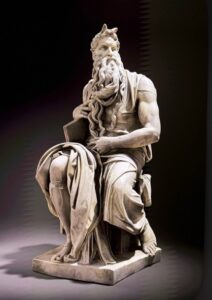
Enzo Pasquini produced this 1966 Marble reproduction, a replica statue of Moses, after Michaelangelo (1475-1564) produced in Rome between 1513 and 1515 (Wiki). Courtesy of Forest Lawn Museum, Los Angeles, California. The horns are attributed to a translation error.
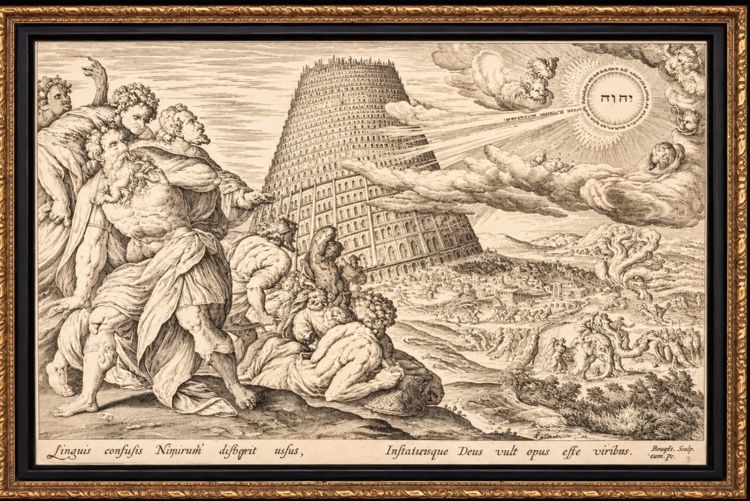
“The Confusion of Tongues from the Story of the Tower of Babel” an engraving by Hans Collaert the Elder (born 1545 in Brussels, died 1580 in Antwerp), was printed ca. 1578, about 50 years after the sculpture’s completion. The engraving hangs a few feet around a corner from Pasquini’s Moses. They echo and reverberate the problems of language, translation, meaning and understanding. The word in the upper right-hand corner is Adonai. (Reproduction of engraving on paper).
If you have plans to visit Los Angeles, the Museum is a must see. Parking was not a hassle. I suggest a weekday. The spacious spaceship-like exterior, the inviting interior architecture, and the welcoming staff make for friendly excitement. Captions are in English and Spanish. Be prepared for overstimulation. The coffee shop provides a respite; the gift shop has alluring Channukah tchotchkes. Next time we visit will make reservations to dine in the fifth floor roof top restaurant.
I want to thank Beryl Weiner and Joyce Craig for their technical and translation skills.
*
Oliver Pollak is a freelance writer based in Richmond, California.