By Barrett Holman Leak in Chula Vista, California

Founded in 2013 by Pastor Dumisani Washington, the Institute for Black Solidarity with Israel (IBSI) is a nonprofit organization dedicated to strengthening the historical, cultural, and diplomatic ties among Israel, the Jewish people, and people of African descent. Through educational forums, leadership training, and media advocacy, IBSI pushes back against anti-Zionist narratives—such as the charge that Israel is an apartheid state—while highlighting the shared civil rights history between Black and Jewish communities and promoting mutually beneficial partnerships between Israel and African nations.
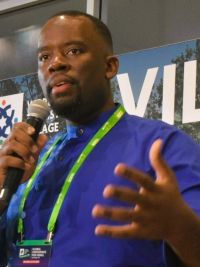
Joshua (Josh) Washington serves as the Director of IBSI; a composer, recording artist, and speaker. He leads the organization’s educational programming and musical outreach, lecturing widely on the historic Black-Jewish alliance and dispelling misconceptions about Israel.
A central pillar of IBSI’s mission is organizing educational delegations and Holy Land pilgrimages that connect Black Americans and African leaders directly with Israel. These trips—such as the prominent “Unfinished Business” tour (which recently brought roughly 500 Black American and African Christian leaders to Israel in November 2026)—are designed to fulfill the Rev. Dr. Martin Luther King Jr.’s postponed 1967 plan to lead a mass pilgrimage of Black Americans to the Holy Land. During these visits, participants tour historic sites, engage with Israeli society (including Ethiopian Jews and survivors of the October 7 attacks), and experience the country’s multiethnic democracy firsthand, equipping pastors, students, and community leaders to foster informed solidarity back home.
The Village Talks at The Jewish National Fund’s Global Conference 2026 in Chula Vista is featuring dozens of short talks, TED-style. One of them that I listened to was by the younger Washington and it managed to harmonize Zionism with music and healing. You see, for Washington, music is more than just performance—it is a lifeline and the most powerful tool he has to reach people.
Performing and learning alongside his father, (who served in February 2025 as Playing Together Project’s Scholar-in-Residence in San Diego for a weekend of forums on Zionism and the Black Church), Washington discovered early in life how to engage crowds and weave messages directly into hearts and minds much faster than spoken words ever could.
When tragedy struck and Josh’s wife, Olga, died unexpectedly on January 6, 2025, music became a vital way to navigate the grief and connect with others. As a composer who also brings orchestras together, Washington uses his artist platform to share music that speaks to different points of history, his deep convictions, and the pain of personal loss.
He has found that the moment the music starts, people’s hearts open up, creating a genuine connection that bridges divides even when listeners might not initially agree with his message.
“As soon as we start playing, people’s hearts are just opened up,” Washington said. “With the music … it’s the most important way to reach people, because it draws people in. In my experience, I found that most people stick around, even if I say things that they don’t agree with. They see something here that’s real, like a genuine connection, and they stay.”
After his Village Talk, Washington and I took a few minutes to have a brief conversation, an edited version of which I present here.
BHL: All right. So, I wanted to get some words. Would you talk about the connection, for you, between the music and healing?
JW: “… Yeah, music has a way of, just like food, but like, it just connects people. Even if we don’t speak the same language, or agree on anything, music, you know, is… is so universal. And so, being able to do it before I even say anything about Israel, I think … it brings people together, and then it makes a lot of people more receptive to whatever … I do need to say … “
BHL: And how would you say that just your connection to Israel has affected your music?
JW: First, just on a music level, like Israeli music is always so inspiring. Israeli jazz; old, traditional Mizrahi music; Ashkenazi music. There’s a lot—to me, I always say like, I can hear. I can always hear the pain and the beauty in, for instance, Hatikvah. You can hear, you can feel the weight of the past. … Just growing up wanting to be a film score composer, growing up, wanting to be an orchestrator, which I am now; for me, listening to Jewish music, listening to it—that’s, to me, that’s the most emotional music that I’ve ever heard. … Just having the connection to Israel, you know, my late wife was buried in Haifa. The way we met was that both of us were doing Israel work, and so then we started doing it together. … “
BHL: Since October 7th, what would you say has been the impact …on what you’re doing now and what your vision is for the future?
JW:” … My wife happened to be in Israel on October 7th, for a JNF event. She was going for something else, so there was already that—for me, there was that connection there. Then after she passed, and just constantly being in this—just being able to see her work and her legacy all around us, for me, it’s become an even more personal thing. I think for me, I’ve shifted into a different space simply because of our marriage, and what Israel really means to me personally; how our friends in Israel surrounded us in the middle of the war. We buried her there in Haifa and there were like 200 people there. There were still hostages, you know, there’s still missiles flying, and people came out to mourn with us. That, to me, is—who Israel is. … My Jewish brothers and sisters really held me up and my family, when we needed them most. …”
*
Barrett Holman Leak is a freelance writer based in San Diego.