By Sandi Masori in La Jolla, California

One of my very favorite events at the annual Jewish Arts Festival is the food and culture night.
Every year the organizers choose a different Jewish community to highlight. This year it was South Africa.
The general formula is some sort of entertainment program, music or song, or an excerpt of a play, a lecture and of course authentic kosher food.
This event quickly sells out every year, so I highly recommend getting tickets early when the next JFest event is announced.
For the second year it was held at Adat Yeshurun Synagogue in La Jolla.
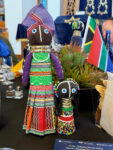
When you walked in you saw the South African flags and traditional South African dolls everywhere.
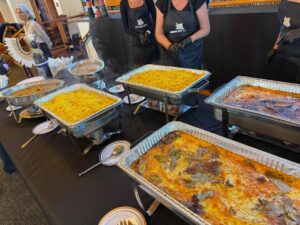
Davina Turobiner Catering provided the menu which included small sausages called Boerewors, Burekas, and cabbage salad on the tables for appetizers. The dinner itself was served buffet style and featured a dish called Bobotie, which was a savory ground beef dish with an egg custard topping. It was very tasty. They also had Yellow Turmeric Rice, Veggie Coconut Curry and a sauce called Sambals which is usually used to mitigate the spiciness of the food. The dishes in this presentation were not spicy though.
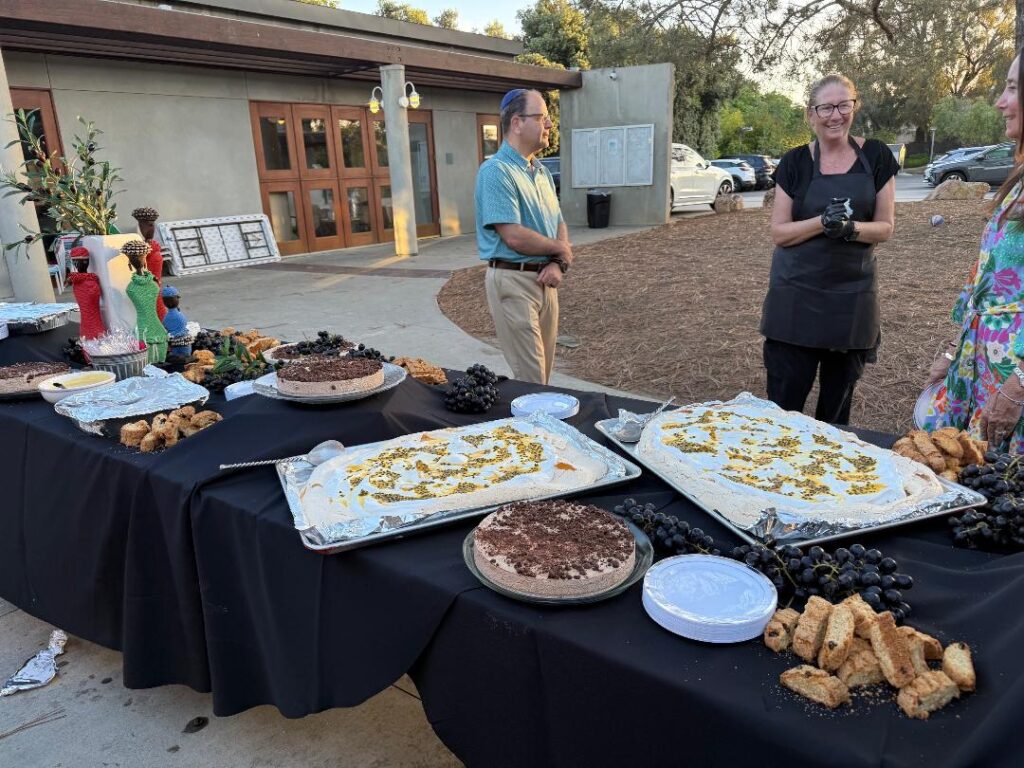
A delicious dessert buffet was prepared by Yael Aires featuring an array of tantalizing options.

While dinner was served Colin Schachat sang and Raymond Goldstein provided musical accompaniment. The songs were familiar, eastern European style.
Later, when Brian Marcus, a past congregational president, spoke, we learned that most South African Jews were originally Lithuanian refugees.
Marcus also shared that when they first came to South Africa from Lithuania in the late 19th and early 20th centuries, Jews became peddlers, traders and small business owners, similar to the American Jewish immigrant stories.
The central Jewish representative body, the South African Jewish Board of Deputies was established in 1912.
The Jews in South Africa had a complicated standing under apartheid. They were white but also not white. So, they had privilege inside the apartheid system but also were not really fully accepted.
Though they benefited from the system as “white” a disproportionate percent of Jews opposed the apartheid regime. When I asked some of the event goers how they felt about it, I was told that it was fairly split between those who opposed the system, and those who supported the ruling party and the benefits of the system.
Zionism has long been a core aspect of their Jewish identity with high participation in Aliyah and Jewish national life.
Most of the community followed the Orthodox framework, especially in culture if not in practice.
When the Jews emigrated from South Africa, they mostly went to Israel, Australia, the U.S., the UK and to Canada. These emigrations really started en masse around 1976 with the Soweto uprising.
All in all, the evening was a fascinating and delicious education.
There are still a few JFest events left in the season. I recommend checking out the JFest website and signing up for one of them.