By Shor M. Masori in San Diego

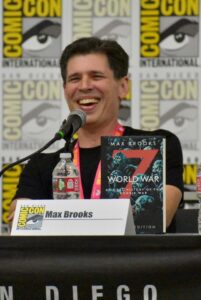
Jewish horror writer Max Brooks told the audience at a Comic-Con panel titled “Creature Feature Reboot: Monsters of Horror” that the present is a scary time, though not necessarily a dark one. It is a time of change, and human beings hate the unknown.
Brooks said his chronological cohort, Generation X, has it worst these days. They came of age during a rare period of stability in human history that they perceived as the norm. Author Marshall L. Moore, speaking from a millennial perspective, pushed back. His generation entered adulthood after Sept. 11 and the 2008 recession, with disruption already built into its understanding of the world. Surely, they have it worst.
As a member of Generation Z, I scoff. I am 25. Many millennials remember the sense of national unity that followed Sept. 11. Their adulthood started with politics as boring and not infecting every facet of culture. My generation doesn’t remember the unity after 9/11. We came of age in the period of political division, distrust, and a sense that our lives will, on average, have worse outcomes than our parents’.
Instability did not interrupt the world we knew. It’s all we’ve ever known. However, I don’t think it needs to be a contest. Everyone is struggling with the chaos of today, young and old.
That may explain the stories people are seeking. Real life rarely supplies a reachable villain, a final confrontation, or a catharsis that interprets what the suffering meant. Stories can give fear a shape and meaning.
My mother reads the last chapter of a book first. She wants to know where the story is going before she begins. Life does not offer that option. We move through it without knowing what waits in the next chapter nor much of the reasoning behind why suffering must exist.
The writers on the monster panel separated fear into three parts. Dread is the sense that something may be waiting in the darkness. Terror begins when the threat is understood but remains unseen. Horror arrives when the creature is revealed.
Moore advised writers to delay that moment. Brooks joked that some horror movies of the 1970s benefited from poor special effects because the filmmakers had to hide their monsters. Once everything is explained, the fear loses its hold. One panelist said it is hard to fear a ghost after learning its Social Security number.
A horror story eventually identifies the thing in the dark. Someone confronts it, survives it or fails. Either way, the audience receives an ending.
Brooks said the same uncertainty has driven people toward shows such as Ted Lasso and Schitt’s Creek, where warmth, empathy and community provide the answer. Guillermo del Toro’s Pan’s Labyrinth carries fear and hope within the same story.
Set in fascist Spain in 1944, the film follows Ofelia, a girl living under the control of Captain Vidal while completing a series of fairy-tale tasks. During the film’s 20th-anniversary Comic-Con panel, del Toro described a conflict between two wills. Ofelia holds no power in the physical world, but Vidal cannot control her inner life. Vidal controls soldiers and a household, yet his authority depends on obedience, and he truly has nothing inside of him.
The Faun and Pale Man are the film’s most recognizable creatures. Del Toro said monsters incarnate fears that already exist. Vidal wears a military uniform, tortures prisoners, and kills anyone who challenges his control. Ofelia defeats him through refusal. She will not surrender an innocent life simply because someone with power orders her to do it.
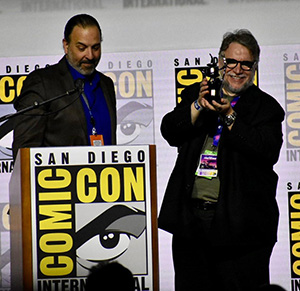
Del Toro made the film about Francisco Franco’s Spain, but its questions have followed it into the present. What does a person do when cruelty becomes policy? What remains under individual control when institutions reward obedience?
Del Toro received Comic-Con’s coveted Inkpot Award from Comic-Con’s director of programming Eddie Ibrahim this year. The film returns to theaters Oct. 9 in 3D and HDR. Del Toro required the restoration team to make every dimensional and visual decision by hand. Generative artificial intelligence was prohibited.
“We are protecting a lineage of art,” he said. He warned that removing a generation of artists from the process would also remove the knowledge they would have carried forward. For more on artists passing on institutional knowledge to younger creators, read yesterday’s story found here.
Unfortunately, this institutional knowledge is under threat in more ways than one.
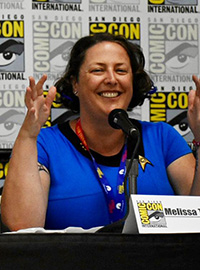
Melissa Miller, a staff research associate at the Scripps Institution of Oceanography, spoke during Comic-Con’s “Everyone’s a Critic” panel about autonomous floats that collect chemical and biological information from the ocean for years at a time. Miller said her team had to remove the phrase “climate change” from a National Science Foundation proposal to keep the research fundable.
The floats could still collect evidence of changes in the ocean as long as the proposal avoided naming the larger crisis the data would help scientists understand. Miller’s work is part of a global network of autonomous instruments capable of gathering information in conditions research vessels cannot continuously cover.
Science fiction provides another route into subjects that have become difficult to name.
During “The Science of First Contact: Star Trek,” a NASA scientist was asked what he would do with unlimited resources. His first answer surprised the audience and other panelists. Rather than spending the bulk of the money on scientific advancement, he’d want to give more support to the people who already desperately need it. Then do great leaps in scientific advancement.
Stories set in starships may travel beyond the known world, but the questions inside them come from home. Who receives the benefits of technology? What can humanity repair once resources are no longer the excuse? What kind of society deserves the future it imagines?
Unfortunately, many of those imagined futures are now being imagined by companies that are built on creative work taken without permission.
At “The Fight for Human Creativity in the Age of AI,” University of Chicago computer science professor Ben Zhao discussed Glaze and Nightshade, two free programs developed by his team to help artists resist unauthorized AI training.
Glaze protects an individual artist’s style. It makes subtle changes to an image that are exceptionally difficult for a human viewer to notice but cause a model to read the work as belonging to a completely different visual style. Artists without computers powerful enough to run the program can use WebGlaze. Their files are transmitted through encrypted connections, processed, and deleted from the project’s servers.
Nightshade addresses the training process. It changes the relationship between an image and the concept an AI model learns from it. A model trained on enough protected images can begin forming incorrect associations. Where Glaze shields a style, Nightshade creates consequences for scraping protected work into a dataset.
The panelists rejected the idea that generative AI’s control over creative industries is inevitable. Companies are selling services, lobbying for rules and making business decisions. They are not the only ones with decision-making sway. The primary purpose of the panel was to get the audience to sign their Let’s Be Clear petition demanding transparency about what art AI is generating its data from in California. If you’d like to support it, you can sign the petition here.
The same hunger for agency appears in Marvel’s Wolverine. The X-Men, created by Jewish Americans Stan Lee and Jack Kirby, have carried stories of persecution through generations of comics. In the upcoming game, mutants remain hidden while human-supremacist billionaire Bolivar Trask pays cybernetic Reavers to hunt them.
The developers said they wanted people who feel powerless to experience power through playing as Wolverine. Logan can find the people hunting mutants and fight back, allowing players to simulate fighting oppressive agents.
This certainty of purpose can be hard to gain as easily in real life.
Although my mother reads the last chapter first because she hates anticipating what may happen, the rest of us move without that ability. We do not know when this period of instability will end, whether institutions will recover public trust or how technology will reshape the work people do. Stories cannot supply those answers. However, they can give a person something to hold on to before the answer arrives.
*
Shor M. Masori is a San Diego-based freelance writer.
Pingback: Recipients of legacy franchises such as Star Trek should render honor to those who came before – San Diego Jewish World