By Eva Trieger in San Diego

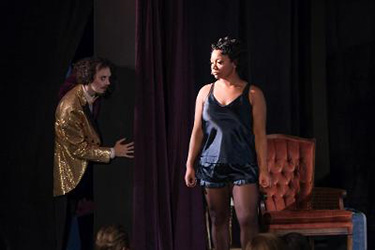
3 Peace Studios has teamed up with Point Loma Playhouse to invite San Diego audiences to experience an “uncomfortably immediate theatrical experience.” They’ve succeeded. The totally immersive collaborative production of Cabaret is such a visceral, gut-twisting event, that remains with the viewer long after the final curtain.
Everything about this show is intentional and purpose-driven. The story depicts the mood of Berlin during the late Weimar Republic. And even though we are living in 2026 America, the familiar undercurrent of baseless hatred is simmering just below the surface.
In Berlin the targets were Jews, homosexuals and anyone who didn’t kowtow to the Reich. Our current daily newspapers reveal frequent incidents of animosity towards anyone who is not in the majority. What message has eluded humanity for the past century that enables a dominant segment of the population to oppress and quash divergent views?
The woman responsible for bringing this hard-hitting show to San Diego is the deceptively diminutive Jailyn Osborne. Osborne’s petite frame belies the tour de force within. The director, choreographer, talent scout and coach sought out the perfect actors for this challenging musical production. She specifically wanted the show to provide access for individuals who typically lacked entry to theatres.
Osborne found individuals with unearthed potential at open mic nights, local stages, poetry readings and soul singing venues. Once she found these people, she provided extra coaching for untrained vocalists, additional choreography to unschooled dancers, and even bought shoes for a cast member in need. Her singular goal was to create a diverse creative team and build a cast that could deliver the profound message of what it means to be persecuted for having a minority identity in a cruel society of absolutes.
In a recent phone call Osborne shared that she read through over 200 instagrams and invited people to come audition for the show. She wanted to give these actors access to a safe space regardless of their previous experiences, sexual orientation or background. The result is a thoroughly varied group of exceedingly talented singers, dancers and actors of various ages, shapes and colors.
The Kit Kat Club is home to a live music ensemble replete with piano, percussion, and horns under the direction of Erin Vanderhyde and Chris Gross. The musical score by Kander and Ebb drives the often seductive and provocative dancing, performed by the “beautiful” girls (Kimora Smiley, Noel Jensen and Liv Gonzales). The choreography offers backstory through movement and rhythm, with special attention paid to colors and costumes.
Audience members are not simply watching actors perform. We are patrons of the Kit Kat Club, watching the show, interacting with the emcee (Austyn Meyers). Seated at the table next to us is the American who has come to write his novel, Cliff Bradshaw (Tyler Jiles). And, of course, we are all delighted when the talented British girl, Sally Bowles (Aarin Wilson), takes the stage alternating between bawdy songs and vulnerable ballads.
Through the pulse of the club we are taken on a ride from a raucous, colorful and playful scene to one that grows increasingly fraught with tension. The subtle undercurrent of rising Nazi power and coercion bubbles to the surface of characters’ lives and loves.
Bradshaw finds lodging at Fraulein Schneider’s (Linda Benning) rooming house. It’s a bit rundown, and though the pensioner wants to keep it respectable, she cannot keep her boarder, Fraulein Kost (Ava Castaneda) from sneaking in a sailor … .or several! After all, she is a working girl and times are hard. It is also here that Bradshaw meets Ernst Ludwig (Brad Krepps), his first English student, and a German businessman.
A sea change occurs when a young boy sings a solo at the club (Cooper Kistler). This Hitler Youth brings with him a wave of sobriety. Amid the confusion and climate of encroaching fear, humans continue to seek love and companionship. Herr Schultz (Jim Thompson MacLaine) reveals his tender feelings for Fraulein Schneider. This triggers a schism and much as they’d like to, the characters cannot unsee what has been brought to light.
The first act is quite long, approximately 1 hour and 40 minutes. What began as an exuberant, giddy party devolves into a menacing, uncertain evening. The tension is signaled not only in the dialogue between characters, but perhaps even more through the dancers’ bodies, props and costumes.
The second act contains some of the very best acting I’ve ever witnessed in San Diego. The Kit Kat Club becomes a place of danger as Berlin succumbs to the Nazi presence. Each of the characters reveal their loss of hope or utter desolation about their imagined futures. The artistry put into this finale defies description.
This production goes well beyond the retelling of a difficult period in the history of our world. It is co-produced by Kara Tuckfield and Jailyn Osborne, who have a vision of bringing true art to audiences and providing a safe space for artists who have been denied the access and opportunity to grow into their potential. In the words of Herr Shultz, “Mazel? We could all use that.” It is just as true today as it was in the 1930s.
Cabaret will run through August 30th at 3148 Fifth Ave, San Diego. Tickets may be purchased at plplh.com or by phone at 619.800.5497
*
Trieger is a freelance writer specializing in the arts.