By Cailin Acosta in San Diego, California
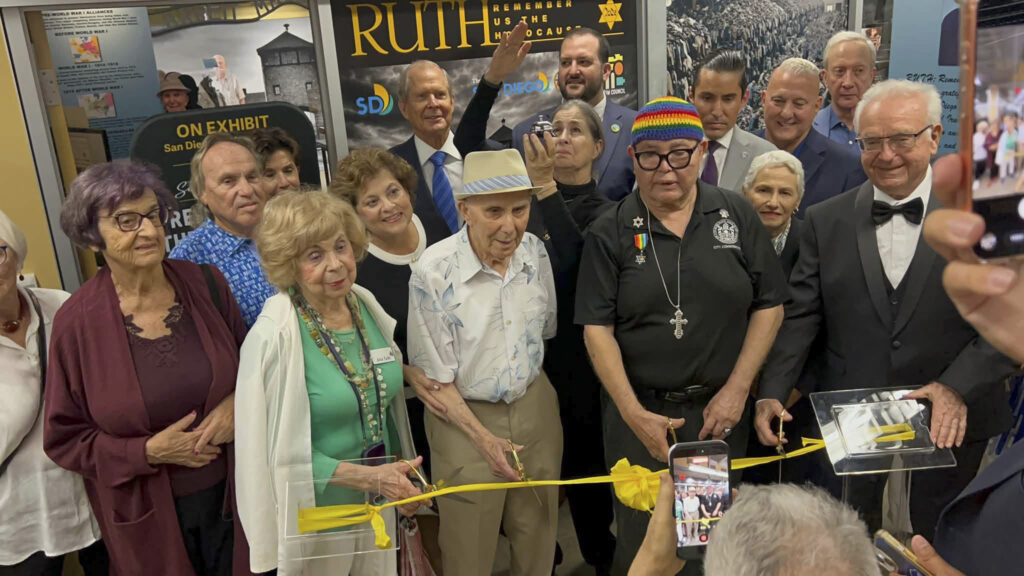
A temporary Holocaust exhibit at the San Diego Central Library is helping pave the way for a permanent Holocaust museum in San Diego, bringing together survivors’ testimonies, historical artifacts and a commitment to educating future generations about antisemitism, hatred and the importance of remembrance.
The opening of the exhibit, presented by Remember Us the Holocaust, drew Holocaust survivors, community leaders, elected officials and supporters who gathered to honor those who perished, recognize survivors and celebrate progress toward establishing a permanent home for Holocaust education in San Diego.
For Sandy Scheller, founder of Remember Us the Holocaust and daughter of Holocaust survivors Kurt and Ruth Sax, the project began with a desire to preserve her family’s history. Over time, that effort expanded into a mission to collect and share the stories, photographs, documents and artifacts of Holocaust survivors throughout the region.
Scheller thanked the organization’s board members and the many community supporters who have helped sustain the project. She emphasized that the work has reached a turning point: The goal is no longer simply to present temporary exhibits but to establish a lasting institution.
“We don’t want exhibits anymore. We want a museum,” Scheller said. “We must have a museum.”
The proposed museum would give San Diego a permanent place to preserve Holocaust history and ensure that the experiences of survivors remain accessible to generations who will never have the opportunity to meet them.
Dr. Moises Salinas Fleetman, Executive Director, a former university president and longtime community leader who is helping guide the museum’s development, announced that Remember Us the Holocaust had signed a letter of intent with the Arts District at Liberty Station to establish the museum there.
Liberty Station offers an established cultural destination and a historic setting in which visitors can engage with the Holocaust’s history and its continuing lessons. The proposed museum would be designed as a journey, moving visitors from Jewish life before the Holocaust through the rise of Nazism, the gradual loss of rights, persecution and deportation, and ultimately liberation, survival and the rebuilding of lives after the war.
Salinas explained that the experience would begin by introducing visitors to ordinary Jewish life, families and communities before showing how antisemitism and Nazi persecution transformed Jewish lives. As the historical narrative progresses, the physical environment would reflect the increasingly restrictive conditions imposed on Jews.
The experience would then move toward liberation and the difficult process of rebuilding. Visitors would learn about the lives survivors created after the war and conclude in a reflection space intended to encourage consideration of the lessons of the Holocaust and the responsibility to confront hatred.
The museum would rely on authentic artifacts, historical context and survivor testimony rather than graphic simulations.
Among the artifacts discussed at the opening was a fragment of a Torah scroll that had been used as wrapping paper by the Nazis. According to Salinas, the artifact had been recovered in Poland and was later at risk of being sold at auction. After efforts involving organizations and officials in Israel and Norway to prevent the sale, Scheller intervened in helping secure its donation to Remember Us the Holocaust.
The Torah fragment will serve as tangible evidence of the destruction of Jewish religious and cultural life under the Nazi regime. Salinas praised Scheller’s efforts to ensure that the artifact would be preserved respectfully and made available for educational purposes rather than ending up in a private collection.
A central feature of the proposed museum will be the survivors themselves. The plan calls for five or six survivors to guide visitors through their personal stories, connecting historical objects with the people whose lives were shaped by the events they represent.
During the opening, Holocaust survivor Ben Midler spoke about the importance of continuing to share these experiences with younger generations. Having spoken to thousands of students, Midler emphasized that survivors will not be available forever to tell their stories firsthand
He urged the community to continue educating children and to create a permanent museum that will carry their testimonies into the future.
The museum’s educational mission will extend beyond teaching students what happened during the Holocaust. Organizers want young visitors to understand how hatred develops, recognize warning signs and learn how to respond when others are targeted.
That goal is the foundation of the proposed Ruth leadership program, named in connection with Scheller’s family legacy. The program would guide students through five stages: remembering the Holocaust, understanding its history and evidence, recognizing antisemitism and other forms of prejudice, learning how to respond, and taking action through projects in their schools or communities.
Students would learn to identify stereotypes, conspiracy theories, propaganda, dehumanization and misinformation. They would also develop communication, problem-solving and coalition-building skills to help them challenge prejudice and support people facing discrimination.
Organizers stressed that applying the Holocaust’s lessons to contemporary issues does not mean equating every act of prejudice with the Holocaust. Rather, the program would begin with the historical specificity of the Nazi genocide and explore the responsibility that emerges from understanding that history.
“We want to develop young people who know what to do with what they know,” Salinas said.
The long-term vision also includes partnerships with educational institutions and organizations experienced in combating antisemitism, promoting student leadership and encouraging civic engagement. Organizers said collaboration would allow the museum to serve as a community hub for education, research, internships and leadership development.
Another significant announcement was a collaboration agreement with the Historical Jewish and Holocaust Museum in Mexico City. The partnership will give the proposed San Diego museum a binational dimension and provide opportunities to display important artifacts from the Mexican institution.
The Mexico City museum, which had served generations through its Holocaust education work, was forced to close after its building was damaged in the 2017 Mexico City earthquake. Representatives of the institution were thanked during the opening for entrusting San Diego with part of its historical legacy.
The partnership reflects the organizers’ broader vision of serving San Diego and the surrounding binational region through educational programming in English and Spanish.
The opening also highlighted support from local government officials. San Diego County Supervisor Paloma Aguirre, who represents District 1, praised the exhibit as an important resource for reflection, education and remembrance.
Aguirre noted that San Diego has a longstanding Jewish community that includes Holocaust survivors and their descendants, yet the region has lacked a permanent Holocaust museum. She expressed support for the effort to establish one at Liberty Station.
At a time when antisemitism, hate speech and intolerance remain serious concerns, Aguirre said education is one of the strongest tools available to counter hatred.
San Diego County District Attorney Summer Stephan also voiced her commitment to fighting hate and ensuring that Jewish children, along with children from all backgrounds, can practice their religions without fear.
Nick Serrano, deputy chief of staff to San Diego Mayor Todd Gloria, represented the mayor at the event. He recalled touring the exhibit with Gloria and said the stories of survivors who became part of San Diego made a lasting impression.
Serrano described the Central Library as an appropriate setting because libraries preserve knowledge and provide opportunities for people of different backgrounds to encounter history. He said the city was proud to host the exhibit and support the effort to establish a permanent museum.
He also reiterated the importance of the principle that “never again” must apply not only to Jews but to all people threatened by hatred, dehumanization and indifference.
Jordan Z. Marks, San Diego Tax Assessor and advocate against antisemitism, spoke about the importance of confronting hate rather than remaining silent. He recounted an antisemitic incident at a San Diego Padres game, where he heard a couple make an antisemitic comment about a visiting player while his 7-year-old son was present. Marks said he spoke up, and the incident prompted an outpouring of community support, along with criticism from people who questioned his account.
Marks credited Commissioner, Nicole Murray Ramirez, with encouraging him to share his experience publicly and emphasized the importance of allies standing with the Jewish community. He also highlighted efforts to combat antisemitism locally, including support for a permanent Holocaust museum in San Diego. His remarks underscored the need to challenge Holocaust denial, recognize antisemitism and ensure that future generations understand the consequences of hatred and indifference.
The event recognized several Holocaust survivors, including Anita Fuchs, Maria Coleman, Ben Midler and Jerry Zamish. Their presence underscored the personal responsibility felt by organizers and supporters to preserve survivors’ experiences and ensure that their voices continue to be heard.
The organization also introduced the RUTH Award, representing Remembrance, Unity, Truth and Honor. Scheller presented awards to individuals who had supported the museum effort, recognizing their commitment to preserving Holocaust memory and advancing the project.
For Scheller, the museum represents both a continuation of her family’s story and an obligation to future generations. The effort has grown from preserving the memories of her parents into building an institution where survivors’ experiences can continue to educate people long after the survivors themselves are gone.
The next phase will require continued work on design, technology, historical scholarships, educational programs, partnerships and fundraising. Organizers invited attendees to indicate how they might contribute, whether through professional expertise, community connections, advocacy or financial support.
The vision is for students to visit the museum, learn directly from survivors’ experiences, participate in leadership training and develop projects that address hatred in their own communities. Those students could then return as mentors for future participants, creating a network of young people committed to remembrance and action.
For San Diego, the proposed museum would provide more than a place to study a dark chapter of history. It would create a lasting space for Jewish history, survivor testimony and community education while encouraging visitors to consider their own responsibility to challenge prejudice.
As the organization moves toward establishing its permanent home at Liberty Station, its message remains rooted in the lessons of the Holocaust: remembrance must be accompanied by education, and education must inspire action.
“Never again to anyone, anywhere,” Salinas said.
Click here to learn more of the Remember Us the Holocaust exhibit at the San Diego Central Library and the future plans for the museum at Liberty Station. The exhibit will be on display on the second floor of the Central Library until Fall 2028.
*
Cailin Acosta is the assistant editor of the San Diego Jewish World.