By Sheila Orysiek

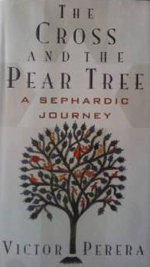 SAN DIEGO–Victor Perera in his book The Cross and the Pear Tree; a Sephardic Journey, (Knopf Publishers, 1995), uses his search for his grandfather’s grave as a means to discover his earlier ancestors. He traces his lineage through documents supplemented by conjecture, from the first settlements of Jews in Sepharad – Spain – through the centuries and into the present generation.
It is estimated that in response to the Edict of Expulsion (1492), the Jewish population broke roughly into thirds; one third chose conversion to Christianity, one third converted but secretly continued to practice Judaism, and one third left the country. Those who stayed and converted – either truly or falsely – did so for many reasons: age, health, fear, poverty, avarice and even lethargy.
Those who left were stripped of all their property, but often their true wealth lay in their skills and many were welcomed in other places such as the Ottoman Empire, Holland, Egypt, Salonika and Amsterdam. A few were invited back to London (Jews had been expelled from England in 1290). Some went west to the newly discovered lands of South and Central America.
The migration was not a single event, but a continuing flow out of and even back to the Iberian Peninsula. Families which had converted, or pretended to, were broken up; some leaving, some staying, some remained Christians, some reclaimed their Judaic heritage. Many upon converting took on Christian names, then years later when opportunity enabled them to leave they assumed Hebrew based names. Missing family or to pursue commercial gain, some returned to Spain and once again resumed Christian names and identities. All of this makes it difficult to trace ancestry.
Perera traveled through the Iberian Peninsula as well as the many other places where communities of exiles were known to have lived, searching for evidence of his forebears. The several family names of his ancestors proved to be fairly common – such as “Cohen” is today. The reader, however, profits from the history the author explores and a sense of the constant flow of people moving across oceans and continents in search of safety.
Many of Perera’s family reside in Israel and from his travels through the West Bank he paints a mostly negative picture of Israeli administration and soldiers. However, he does not give much of the context which causes the Israelis to respond as they do.
In the end, his search for his grandfather’s grave in Alexandria, Egypt, is almost anti-climatic as he gets caught up in detailing his dysfunctional family. To go from the grand (as in “large”) historical events such as the Expulsion and its consequences to the sordid details of his sister’s mental health challenges and his mother’s negative influence is jarring.
This reader enjoyed the trip through history but would rather the intimate family problems had been kept private, especially since they are not part of the originally stated intent of the book. The mixture of the two seemed a pretext for airing personal wounds.
*
Orysiek is a freelance writer who specializes in arts and literature. Comments may be made in the space provided below this article or sent to the author at sheila.orysiek@sdjewishworld.com