By David Amos
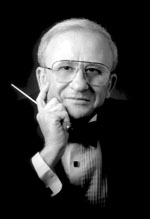
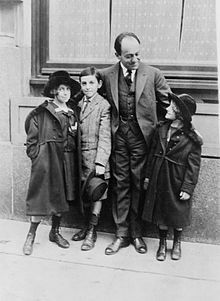
SAN DIEGO — The next presentation of the Tifereth Israel Community Orchestra will feature the music of the greatest composer of Jewish music in the Twentieth Century.
Ernest Bloch gave us some of the most beloved orchestral music on Hebraic themes, but he also composed secular orchestral music of great depth and emotion. The TICO Orchestra will play Bloch’s Concerto Symphonique For Piano And Orchestra, the Violin Concerto, and the Concerto Grosso for No. 2 for Strings, on Sunday, March 22 at 3:00 p.m. and Tuesday March 24 at 7:30 p.m..
An additional evening featuring a monodrama, The Return of Ernest Bloch will be given on Thursday, March 26, 7:30 p.m. The latter is without orchestra, with solo violin, piano, and dramatic narrator, telling the story of Bloch. The actor will be Simon Ordever, recognized in San Diego for his many activities in the Jewish Community. All three programs will be held at Tifereth Israel Synagogue’s Cohen Social Hall.

I had the pleasure of conducting recordings two of these compositions back in 1990 with the London Symphony Orchestra.
Our guest musicians for the Tifereth Israel performances will include violinist Raimondas Butvila and pianist Zecharia Plavin, who also wrote the monodrama. Plavin comes to us from Israel, and Butvila from Lithuania.
These events mark an intriguing culmination in the lives of three people whose lives Ernest Bloch (1880-1959) played a crucial formative role. I have been promoting the music of living or recently living American, Jewish, and Israeli composers, and have attempted to create coherent cultural clusters with their distinctive and benevolent sounds. Among them has been Ernest Bloch.
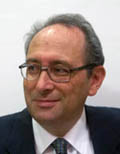
In 1992, I traveled to Lithuania, to do two concerts and a recording with the Lithuanian Philharmonic in Vilnius. I met Zecharia Plavin, who was making his comeback appearance in Lithuania, years after immigrating to Israel in 1977. After a comedy of errors, where I was told to prepare a different piano concerto than the one Zecharia came to play (ask me about this incident sometime), we established deep friendship ties, and have cooperated on various occasions in San Diego and Israel.
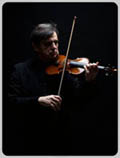
But the friendship that links Plavin with violinist Raimondas Butvila is much older, starting in 1963, when the two boys entered the well-known Curilionis School of Arts for seven years of studies, sat on the same bench, and became best friends. They played together too, both dreaming of fame and artistic success. Still in his early teens, Raimondas achieved fame by outstanding violin playing and by winning numerous international competitions. At the age of 15, he performed Romantic virtuoso solos in tours of Belgium and The Netherlands.
After matriculation, both young men entered the Vilnius Academy of Music (formerly called “The Conservatory”) and started performing in joint concerts. Their friendship continued through their student years and expanded into discussions about the nature of the Soviet Regime, the future of Lithuania, and various Jewish subjects. They went their separate ways in 1977, when the Plavin family received the required exit visa to Israel after a seven year wait. At that time, Raimondas won the diploma in one of the most difficult musical competitions in the world, the All-USSR Competition. Later he studied at the renowned Tchaikovsky Conservatory in Moscow, while keeping a discreet correspondence with Zecharia, who was starting his life in Israel.
A large scale novel can be written about the years of struggles of both Raimondas and Zecharia in their formative years. In the eighties, there was a major event that brought their lives back together. It was Raimondas’ visit to Israel in 1990, for a series of four concerts with the Lithuanian String Quartet; Zecharia joined them in a performance of the Schumann Piano Quintet.
All signs pointed to the hope that the two friends would now resume their personal contact. But the true renewal occurred 17 years later. In the meantime, Raimondas relocated to Caracas, Venezuela and became the musical director of the Emilio Friedman School of Music. Interestingly, one of his violin students was Gustavo Dudamel, who is now the musical director of the Los Angeles Philharmonic. During those years, Raimondas performed a wide repertoire of concertos with Venezuelan orchestras.
While still residing in Venezuela, Raimondas called Zecharia and invited him to perform chamber music in Lithuania. Zecharia reciprocated, and the two musicians started playing annually, with music by Brahms, Beethoven, some of Zecharia’s music, and that of lesser known composers. Since 2011, Raimondas is back living in Lithuania, and is a full professor at the Kaunas Vytautas Magnus University.
Zecharia is a senior lecturer at the Jerusalem Academy of Music and Dance, teaches private piano, and music history at the Hed-Ono Music College in Tel-Aviv.
And they play Bloch, too! Raimondas discovered Bloch in 2009, and has played the composer’s two Violin Sonatas and the Baal-Shem Suite, and in San Diego, next week, the composer’s iconic Violin Concerto. Bloch’s two sonatas were played by Raimondas and Zecharia at the World Congress of Judaic Studies in Jerusalem’s Hebrew University. During these years of commitment to Bloch, Raimondas has been accepted as an outstanding interpreter of the composer, and in Lithuania, he has succeeded in creating a fresh and noble atmosphere in Lithuanian concert life by securing Bloch as part of his country’s artistic world.
I can’t resist mentioning that while I was conducting and recording in Lithuania in 1992, one of the pieces was by Bloch!
Zecharia tells us: “Bloch indeed is an extraordinary figure in the Jewish-Hebraic discourse, by his sheer force of phenomenal inspiration and by force of character. He created musical expression that could best be described as prophetic. By this, Bloch effectively solved the ancient Jewish tension between particularism and universalism, proposing the winning idea of creative universalism, creativity being the distinctive force instead of defensive particularist ideas. The magnitude of his achievements are still beginning to be appreciated. Bloch’s music, in spite of the popularity of several of his compositions, is only nowadays reaching its full acceptance, positioning him as one of the greatest musical geniuses of all time.”
For more information about these three programs, individual or group tickets, reservations, directions, or a season brochure, call (619) 697 6001, or you can buy tickets online at www.tiferethisrael.com/TICO.
*
Amos is conductor of the Tifereth Israel Community Orchestra (TICO) and has guest conducted professional orchestras throughout the world. Your comment may be sent to david.amos@sdjewishworld.com or posted on this website according to the instructions below.
__________________________________________________________________
Care to comment? San Diego Jewish World is intended as a forum for the entire Jewish community, whatever your political leanings. Letters may be posted below provided they are responsive to the article that prompted them, and civil in their tone. Ad hominem attacks against any religion, country, gender, race, sexual orientation, or physical disability will not be considered for publication. Letters must be signed with your first and last name, and you must state your city and state of residence. There is a limit of one letter per writer on any given day.
__________________________________________________________________