Sam Ben-Meir

[caption id="attachment_71775" align="alignright" width="100"] Sam Ben-Meir[/caption]

Sam Ben-Meir, PhD is an adjunct professor at Mercy College. His current research focuses on environmental ethics and animal studies. sam@alonben-meir.com

Short Story: ‘The Conductor’

I am always surprised and rather dismayed whenever I hear my fellows disparage the vocal production of our avian cousins. Do you not know, I want to say, that many birds – from the nightingale to the song sparrow – are consummate musicians? The Lyrebird, that clears a patch of forest floor, prepares his stage on which to sing and dance. Is this not an artist, in the most complete sense? Birdsong is indeed music, a spontaneous expression of how a particular bird experiences and feels the world. So much so that some birds have been known to sing with such intensity and passion that their little hearts have burst in the very e ecstasy of the transport – as if their poor frames could not contain the overwhelming spiritual force of the music. [Sam Ben-Meir]

Short Story: ‘The Conductor’ Read More »

Jewish Fiction, Music, Dance, and Visual Arts, Sam Ben-Meir

Short Story: The Fly

Once upon a time there was a fly – by all outward appearances an ordinary and inconspicuous housefly. But this fly was quite unlike its fellows, unlike any fly that has ever been or is ever likely to be again. For this fly was in love, and not with another fly let me hasten to add. This fly was in love – in love, I say – with a man. [Sam Ben-Meir, Ph.D]

Short Story: The Fly Read More »

Jewish Fiction, Sam Ben-Meir

The Lasting Significance of David Hume

The pandemic, which has taken over three million lives and continues to ravage parts of the world; the rise of Trumpism, culminating in the January 6th attack on the Capitol; the degradation of the environment and the threat posed by anthropogenic climate change; these things, and others, have served to alert many of us that the comfort we take in the notion that what has always been the case one’s whole life will always remain the case is nothing more than a pleasant fiction. Several centuries ago, a Scottish philosopher made a similar observation, and notably took it quite a bit further. [Sam Ben-Meir, Ph.D]

The Lasting Significance of David Hume Read More »

Sam Ben-Meir, Science, Medicine, & Education

‘Mural’ Came From Deep in Pollock’s Unconscious

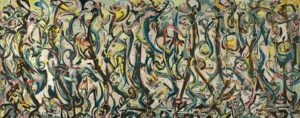
Since at least 2014, Mural (1943) has been on perpetual tour. So much has already been said about this large painting – books are devoted solely to the analysis of Jackson Pollock’s first great masterpiece. What else can possibly be said? In fact, there will always be new things to say. As with any work of genius, it exceeds every interpretation. Mural is generally regarded as a transitional work – between the mythological, Jungian abstractions and the later drip paintings which would secure Pollock’s world fame.

‘Mural’ Came From Deep in Pollock’s Unconscious Read More »

Music, Dance, and Visual Arts, Sam Ben-Meir

Symeon Shimin’s Humanistic Art

This is a moment to revisit and reflect on the work of Russian-born artist, Symeon Shimin. During his life, Shimin illustrated over 50 children’s books, including two that he authored himself; his masterpiece, however – influenced in part by ‘Los Tres Grandes’ – was the mural painting, “Contemporary Justice and the Child” (1936), located on the third floor of the Department of Justice, where it still stands today. [Sam Ben-Meir]

Symeon Shimin’s Humanistic Art Read More »

Music, Dance, and Visual Arts, Sam Ben-Meir, USA
Francisco Goya at the Metropolitan Museum of Art

Perhaps what is most startling about the etchings of Francisco Goya, presently on view at the Metropolitan Museum of Art, is the artist’s intensity of focus, his obsession with understanding the nature of human evil. Goya was a child of the Enlightenment, and he knew what it was to see humanity as the pinnacle of creation, the paragon of animals, the embodiment of reason, “in form and understanding how like a god?” as Hamlet would say. Yet this same creature, the light of reason in the world, was capable of the most barbaric cruelty. In one series after another Goya’s etchings attempt to grasp the universality of evil, to see it as an essentially human problem to be understood in terms of our capacity for moral choice. Evil is universally human, for Goya – a propensity in human beings that is at once basic and inextinguishable. [Sam Ben-Meir, Ph.D]

Francisco Goya at the Metropolitan Museum of Art Read More »

Music, Dance, and Visual Arts, Sam Ben-Meir

Art as Liberation: The Mexican Muralists at the Whitney Museum

Vida Americana is an exhilarating, expansive and immensely satisfying exhibition at New York’s Whitney Museum. Like a great and varied feast, this is a show that one must take one’s time to fully appreciate and digest; an exhibition that includes photography, film, sculpture, charcoal sketches, colored pencil and graphite, watercolors, lithographs and oil paintings, from the easel to the epic in scale. Not only are the greatest Mexican artists of the twentieth century represented here – including Diego Rivera, José Clemente Orozco, and David Alfaro Siqueiros (‘Los Tres Grandes’) – but also many of the notable American artists who they had a profound influence on, such as Jackson Pollock, Jacob Lawrence, Marion Greenwood and Charles White, among others. [Sam Ben-Meir, Ph.D]

Art as Liberation: The Mexican Muralists at the Whitney Museum Read More »

Music, Dance, and Visual Arts, Sam Ben-Meir

OpEd: Power versus Duty in American politics

To anyone paying attention the last four years, Trump’s refusal to accept that he lost the 2020 presidential election fair and square could not truly come as a surprise. That he would never concede was practically a given. What we could not know (and still do not know) with any certainty is just how far Trump will go to maintain his grip on power. [Sam Ben-Meir, Ph.D]

OpEd: Power versus Duty in American politics Read More »

Sam Ben-Meir, USA

The artist as ‘hooligan’ on exhibit at NYC’s Pace Gallery

The Hooligans is Ghenie’s fourth solo exhibition at Pace Gallery, comprised of nine paintings and three drawings, all produced during this last year. It is a sustained engagement with European painting, including J.M.W. Turner, the Impressionists, and post-Impressionists, particularly Van Gogh and Gaugin. Ghenie remarks in a statement about this new body of work: “When I look at the Impressionists, I have the strange feeling that I am looking at something very schizophrenic. Behind those harmless colorful landscapes there is an incredible, destructive force; camouflaged. It is an act of hooliganism.” [Sam Ben-Meir, Ph.D]

The artist as ‘hooligan’ on exhibit at NYC’s Pace Gallery Read More »

Music, Dance, and Visual Arts, Sam Ben-Meir, USA
Anarchism and the Avant-Garde

The Museum of Modern Art is currently presenting Félix Fénéon: The Anarchist and the Avant-Garde – From Signac to Matisse and Beyond, examining the immense influence of this art critic, editor, publisher, collector and anarchist. Fénéon (1861-1944) saw the critic as a channel between the artist and the public – a role which had particular significance because art could further the cause of social justice and harmony. As Paul Signac would proclaim: “Justice in sociology, harmony in art: same thing.” [Sam Ben-Meir]

Anarchism and the Avant-Garde Read More »

Music, Dance, and Visual Arts, Sam Ben-Meir

Film Review: The Last Vermeer

The Last Vermeer – producer Dan Friedkin’s directorial debut – is a well-paced and thoroughly engaging World War II drama. Joseph Piller (played by Claes Bang), is a Dutch Jew who fought with the Resistance during the war; and is now commissioned with uncovering and redistributing art stolen by the Nazis. Enter the flamboyant painter and art dealer, Han van Meegeren (masterfully played by Guy Pearce) who is suspected of selling Dutch art treasures to Field-Marshal Hermann Goering and other top Nazi officials. Piller’s story is complicated by a fraught relationship with his wife (played by Marie Bach Henson), who remained in Holland during the occupation; and while she provided intelligence to the Resistance, the implication is that she was only able to acquire such intelligence by carrying on a romantic dalliance with Nazi officers. [Sam Ben-Meir, Ph.D]

Film Review: The Last Vermeer Read More »

International, Music, Dance, and Visual Arts, Sam Ben-Meir

Material Ecology: Neri Oxman at MMA

By Sam Ben-Meir NEW YORK — The Museum of Modern Art is currently exhibiting Material Ecology, a tantalizing sample of the truly astounding and path-breaking work of Neri Oxman and her team, Mediated Matter group, at the Massachusetts Institute of Technology. Oxman is an American-Israeli architect and designer – yet these designations conspicuously fail to

Material Ecology: Neri Oxman at MMA Read More »

Music, Dance, and Visual Arts, Sam Ben-Meir, USA
Juukan Cave Destruction a Loss for Humanity

The Anglo-Australian multinational company Rio Tinto – the largest iron ore mining company in the world – demolished two 46,000-year-old Aboriginal rock shelters in May. What is particularly disturbing about this event is that Rio Tinto was apparently acting entirely within the law. Which is to say that this kind of tragic and wanton destruction will continue to happen unless stricter regulations are enacted. [Sam Ben-Meir, Ph.D]

Juukan Cave Destruction a Loss for Humanity Read More »

International, Music, Dance, and Visual Arts, Sam Ben-Meir, Science, Medicine, & Education