By Sheila Orysiek
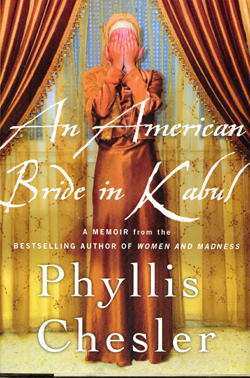

SAN DIEGO–In her memoir An American Bride in Kabul,” Phyllis Chesler, (Palgrave Macmillan Publishers 2013) relates how while in college in 1961, at the age of twenty, she fell in love with an educated, handsome, sophisticated, charming, wealthy man. He was a Muslim from a prominent Afghan family – she was the daughter of an Orthodox Jewish family from Brooklyn.
During the short time they lived together the cultural/religious differences didn’t seem to be an impediment to marriage. His promise of travel to exotic places sounded like a wonderful adventure to her and over the strenuous objections of her parents they were married in a civil ceremony. He wanted to begin by visiting his family in Kabul, Afghanistan.
Immediately upon arrival she was forced to forfeit her American passport. At the time she didn’t realize that this negated her American citizenship and made her the property of her husband. The American embassy could do nothing to help her; she had no proof of citizenship or that the passport had been taken from her without her willing consent. She quickly found herself behind a wall which enclosed a palatial home, populated by the several wives of her father-in-law, their children and enslaved servants.
She was rarely allowed outside, always encased in a burqa and surrounded by a full complement of family “protection.” She was expected to swiftly become a “good Afghan wife” which included conversion to Islam. Her husband had reverted to Afghan/Islamic cultural norms and was no longer recognizable as the man she thought she had married. His one intent was to tie her further into his family by forced pregnancy via physical abuse.
Sickened by the food, beaten, ill with hepatitis, forbidden the few medical services available, and with no pregnancy in sight, she was eventually deemed “useless” by the family patriarch. After negotiating the citizenship issues with a temporary visa, she was allowed to leave Afghanistan and literally kissed the tarmac when she landed in America. However, she continued a lifelong connection with her re-married ex-husband. It was a love/hate relationship, which she seemed psychologically unable to break – still referring to him as “charming.”
The second half of the book is a discussion of the abusive conditions under which so many women and children live; an important issue affecting over one half of the population in dozens of countries.
For that reason alone, this book is worth the time to read.
*
Orysiek is a freelance writer who specializes in arts and literature. Comments may be made in the space provided below this article or sent to the author at sheila.orysiek@sdjewishworld.com
Somewhat hard to get interested in reading a book by someone who is apparently suffering from some level of emotional disturbance. The fact that, even after being cast out of “hell” she is unable to rid herself of a bond with the person who literally imprisoned her makes it difficult to feel any respect for her and therefore my only reason for reading the book would be a morbid curiosity about her sufferings both before she was freed and after. I don’t have that morbid curiosity.