By Jerry Klinger in Boynton Beach, Florida

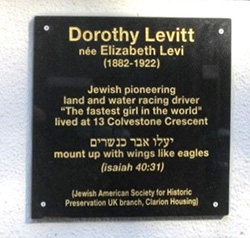
HACKNEY, East London, England — The recently sited marker to an incredible woman, a woman recognized and seemingly forgotten, is short and simple.
Dorothy Levitt
née Elizabeth Levi
(1882-1922)
Jewish pioneering land and water racing driver
“The fastest girl in the world”
Lived at 13 Colvestone Crescent
יעלו אבר כנשרים
Mount up with wings like eagles
(Isaiah 40:31)
The marker was funded and made possible by the interactive cooperation of the Jewish American Society for Historic Preservation (JASHP), Clarion House (property owners), and Martin Sugarman, AJEX archivist – the (British) Association of Jewish Ex-Servicemen and Women.
The Levitt marker is one of nearly 30 markers funded and sited by JASHP and Sugarman throughout Great Britain that visibly present and affirm Jewish historical presence and contributions to Britain. The series continues to expand.
The series is a slap in the face of growing British antisemitism. Antisemites ignore that Jews have been part of British life since the Romans. They obsess over the relatively recent Palestinian issue that Britain played a major role in creating. It is simpler to deny that Jews have been and continue to enrich Britain today. Some antisemites even look forward to a Jew-free Britain, a Britain that will be much poorer, in the future.
The Dorothy Levitt marker clearly illustrates how a single Jewish woman positively transformed Britain, British society, and British attitudes toward women.
Levitt (sometimes spelled Levit) was born Elizabeth Levi on January 5, 1882. Her father, Jacob Levi, a prosperous jeweler, and her mother, Julia Raphael, were of Sephardic Jewish heritage.
The family anglicized their name to Levitt for business and pragmatic reasons. Dorothy grew up, contradictorily described, as shy, even timid, very feminine. By her teenage years, she had become a stunning beauty, rebelliously independent-minded, drawn to excitement and risk, especially with anything linked to motor-driven machines. Levitt ran away from home rather than consent to a marriage she did not want.
A fortuitous encounter with Selwyn Edge, a pioneering British car manufacturer and racing car driver, vaulted Levitt into the racing car world and notoriety. She was introduced to English Royalty and soon was teaching Queen Alexandra and the Royal Princesses how to drive.
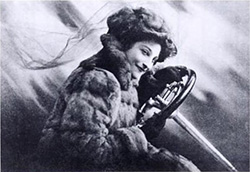
In 1905, she established the record for the longest drive achieved by a lady driver by driving a De Dion-Bouton from London to Liverpool and back over two days. The Press nicknamed her the Fastest Girl on Earth, and the Champion Lady Motorist of the World.
In 1909, Levitt wrote The Woman and the Car: A Chatty Little Handbook for all Women Who Motor or Who Want to Motor (1909)
She described her target audience: “those [women] who would like to, but either dare not because of nervousness, or who imagine it is too difficult to understand the many necessary technical details”
The book taught women what the brake pedal was and how to change a spark plug. Levitt did not shy away from another blunt reality for lone women drivers. She strongly recommended that women drivers carry a gun, preferably a six-cylinder Colt because of its low recoil when fired.
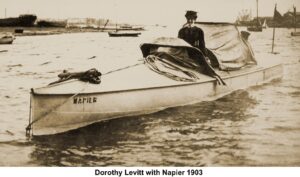
Levitt was one of the most well-known women of the British Edwardian age. Automobiles and racing may have been her first love, but that did not stop her from venturing into motor yacht racing and airplanes.
Levitt never married. She died young, only 39 years of age. Gossip said she was a lesbian. A death inquest noted she died of a drug overdose. The truth was never known and really does not matter.
Dorothy Levitt lived a life full of excitement and accomplishment that guided Britain into the dynamic world of the 20th century. Technological, cultural, and political changes raced on. She was quickly forgotten.
Levitt was buried quietly in the Brighton Jewish Cemetery. Her modest white tombstone reads:
Loving Memory
of
Dorothy Elizabeth Levitt
(Levi)
who passed away 17 of May, 1922
Age 39
For those who will but look – Cemeteries are outdoor museums – windows to a world that made and makes us who we are today.
*
Jerry Klinger is the founder and executive director of the Jewish American Society for Historic Preservation.